

Article January 8, 2026
Academic rigour: What it means and why it matters for every child

“Academic rigour” is a term you’ll find in numerous prospectuses, school websites, and even headteachers’ speeches. Yet, many parents (and even some schools themselves) aren’t quite sure what it really means.
Rigorous learning isn’t about long nights of homework, taking extra classes, or exams that seem to get harder every year. It’s about learning deeply, taking on challenges, and building thinking skills that last well beyond exam results.
The truth is that a rigorous education can benefit all students, no matter your child’s strengths, abilities, and individual needs. Understanding what academic rigour truly means, and how to choose a school with the right level of rigour for your child, can make all the difference to their education journey and their future beyond school.
Here’s what academic rigour actually involves, why it matters for your child’s future, and how to choose a school that delivers the right balance of challenge and support.
What is academic rigour?
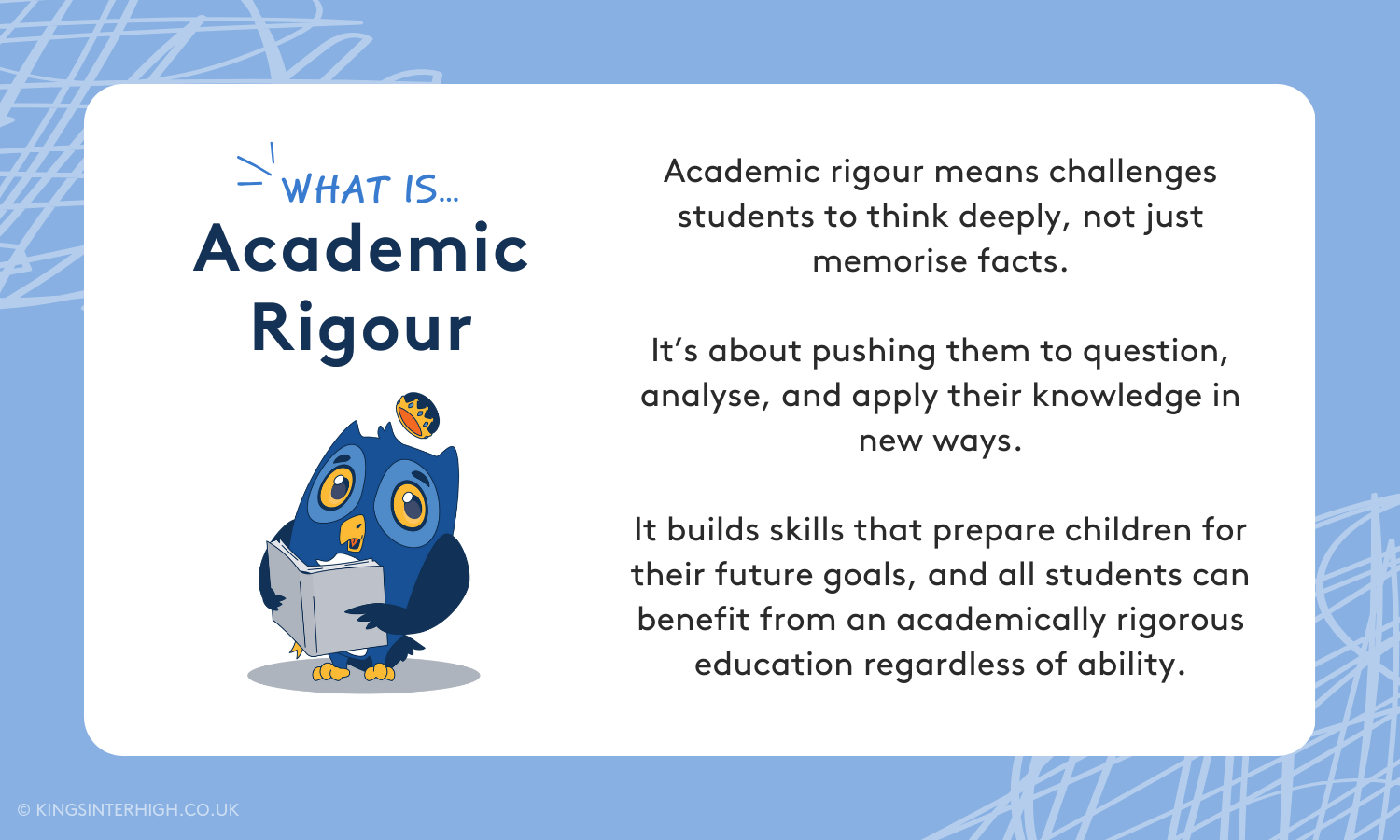
“Academic rigour” typically refers to a standard of learning that’s deep, complex, and challenges students to use high-order thinking skills like analysis, problem-solving, and evaluation.
As a parent, when you hear about academic rigour, you might picture mountains of homework, advanced qualifications, and late-night study sessions. But, in reality, rigour shouldn’t mean piling on work or making school harder just for the sake of it.
At its core, academic rigour is about how students think rather than just what they learn. Instead of memorising facts to pass a test, rigorous learning asks students to engage more deeply with the ideas they’re learning, from questioning knowledge to applying it in meaningful ways.
The goal of academic rigour is to develop young people who can think critically, persist when they’re struggling with a topic, evaluate information rather than accepting it at face value, and clearly convey their unique thoughts.
Does “rigorous” just mean difficult?
Academic rigour isn’t about sitting harder tests or writing longer essays. Rather than difficulty, it’s about depth and complexity in the learning process.
While an average learning experience may include memorising dates in history or formulae in maths, a rigorous programme teaches children how to go deeper by analysing, reasoning, reflecting, and more.
This depth also distinguishes the term “academic rigour” from “academic success.” While grades measure performance, rigour measures intellectual challenge. A student could earn top marks in an exam through rote memorisation, but a learner on a more rigorous course will experience more intellectual growth even if their final grade is slightly lower.

The importance and benefits of academic rigour
Academic rigour can help a child excel beyond their targets and achieve their best grades in school, but there are far more benefits beyond exam success. Rigorous learning is about building a foundation that supports your child throughout their life, guiding them to develop skills that will shape how they think, work, and navigate our changing world.
Let’s take a look at some of the biggest advantages students gain with academically rigorous learning.
Building essential skills for school and life
When students engage with challenging coursework, they’re developing what we call intellectual resilience: the ability to persist when things get difficult. Each essay strengthens their communication, each presentation builds their confidence, and each problem solved hones their reasoning and thinking skills.
These may sound like abstract benefits at face value, but they’re actually practical, transferable abilities that your child will be able to use again and again in daily life. Learning how to break down a difficult mathematical proof, for example, develops the same systematic thinking your child may one day need to manage a budget, troubleshoot tech that’s not working, or solve complex challenges in their workplace.
Rather than just learning content, students in rigorous programmes learn how to learn, as well as how to adapt and grow. As an added benefit, rigorous study can also develop skills like time management and organisation, which are essential for success at university and beyond.

Opening doors to higher education
Similarly, something many parents don’t realise is that universities all around the world place real value on academic rigour. It’s why rigorous curricula (like A Levels in the UK and AP classes in the US) give students a greater chance of getting into top universities than many everyday high school diplomas.
That’s because degree-level coursework requires courage, curiosity, and a willingness to challenge yourself, all of which are part of rigorous study at school level. By studying rigorous qualifications, students can show universities how well they can handle complex material, think independently, and take intellectual risks.
Preparing for a changing world
Academic rigour also prepares students for a future we can’t fully predict. Depending on your child’s age, the career they pursue one day might not even exist yet. Rigorous learning is valuable because it builds cognitive flexibility, which gives students the ability to adapt to new situations and master unfamiliar concepts quickly.
In our increasingly information-rich, AI-driven world, rigour also teaches children how to be discerning. Students learn to question sources, identify bias, and develop their own thoughts. These are the same skills they can one day use to evaluate whether a news article is honest, navigate negotiations at work, and even make the best financial decisions one day.
Plus, learning how to weigh evidence and defend their reasoning also lays the groundwork for ethical decision-making. As part of a rigorous programme, your child will learn how to consider multiple perspectives, understand consequences, and think beyond immediate gratification. These are the attributes that will make them not only successful professionals, but also thoughtful citizens of the world.
Fostering a genuine love of learning
Finally, one of the most valuable outcomes of academic rigour is a sense of enthusiasm and motivation in learning. When students feel the satisfaction of overcoming a learning challenge, education can start to feel less like a task or hurdle and more like something worth pursuing for the sake of knowledge and understanding.
That shift from “I have to study” to “I want to learn more” creates lifelong learners who remain curious and engaged long after their formal education ends — qualities that are perfect for creative and technical career paths.
What academic rigour looks like in schools
Academic rigour has the best impact on students when schools carefully consider how it shapes curriculum, teaching, and everyday classroom life, challenging each learner without creating unnecessary stress.
At King’s InterHigh, for example, we teach the British curriculum (including IGCSEs and A Levels) as well as the IB Diploma Programme. Both are known for their rigour, pushing young people to think deeply and aim high. On top of that, we focus on how our teachers can inspire students to go further, how we can support each child’s individual needs in the classroom, and how we can prevent study from becoming overwhelming.
The foundation of a rigorous curriculum
The foundation of academic rigour is a strong curriculum. Not all curriculums are designed equally, but today’s students around the world have a variety of options available thanks to pathways like international and online schooling.
Globally, the British curriculum is one of the most highly respected educational programmes, and it’s easy to see why. Designed with the needs of each age group in mind, the British curriculum gradually builds in complexity over the years. In primary school, for example, students may learn how to compare different periods of history; at IGCSE level, those same students engage in deeper enquiry to make their own valid historical claims.
By the time students reach the final stage of A Level qualifications, they’re skilled at analysis, application, reflection, communication, and more, setting them up for future success. Similarly, the IB Diploma Programme emphasises critical thinking across disciplines, teaching students how to connect ideas between subjects and develop research skills.

Teaching a rigorous programme
Even with a curriculum that’s inherently rigorous, great teaching makes all the difference. Active learning strategies, for example, are crucial for academic growth. Rather than spending every single lesson lecturing, teachers must use strategies like Socratic questioning (asking thoughtful, open-ended questions to stimulate critical thinking) and project-based learning. From STEM and creative media in primary school to drama and film studies in middle school, many of our subjects are project-based at King’s InterHigh. For IGCSE students, we incorporate regular flipped learning, which allows for deeper discussion and problem-solving during lessons.
Rigorous assignments, meanwhile, go beyond simple recall. They might include research projects that require multiple sources or presentations that need clear communication. At King’s InterHigh, for example, students can present their learning in varied ways, like synthesising their findings together in an interactive, multimedia e-book.
At King’s InterHigh, we also believe that inclusivity and accessibility are crucial. Great schools scale academic rigour by differentiating their teaching, ensuring that every student gets the right level of challenge no matter their needs and abilities. Inspired AI is just one of the ways we do this at King’s InterHigh, giving students a personalised learning pathway outside the classroom with content and activities tailored to their pace.
Balancing rigour with wellbeing
There’s a reason why many parents and students associate academic rigour with overwhelm and stress. High workloads, test anxiety, and the pressure of meeting high expectations can weigh down even the most motivated students.
Without the right support in place at school, a rigorous curriculum and teaching approach stop being a foundation for growth and start becoming a source of anxiety. That’s why any thoughtful implementation of academic rigour should always factor in social-emotional learning, wellbeing support and pastoral care, and an environment where students feel comfortable speaking up when they need help and guidance.
In our weekly tutor group Reflect sessions, for example, students get the chance to discuss topics like workload and organisation to build better personal strategies, confidence, and resilience. Teachers also play a central role in making rigour manageable. The best educators set clear expectations, provide regular feedback, and balance high standards with the support and guidance students need to meet them.
How to choose the right academically rigorous school
Not all rigorous schools are the same, and what challenges one child perfectly might overwhelm or underwhelm another. Finding the right fit starts with understanding your child, then evaluating schools thoughtfully. The goal isn’t finding the “most rigorous” school; it’s finding the environment where your child will be appropriately challenged, well-supported, and set up for a bright future as a lifelong learner.
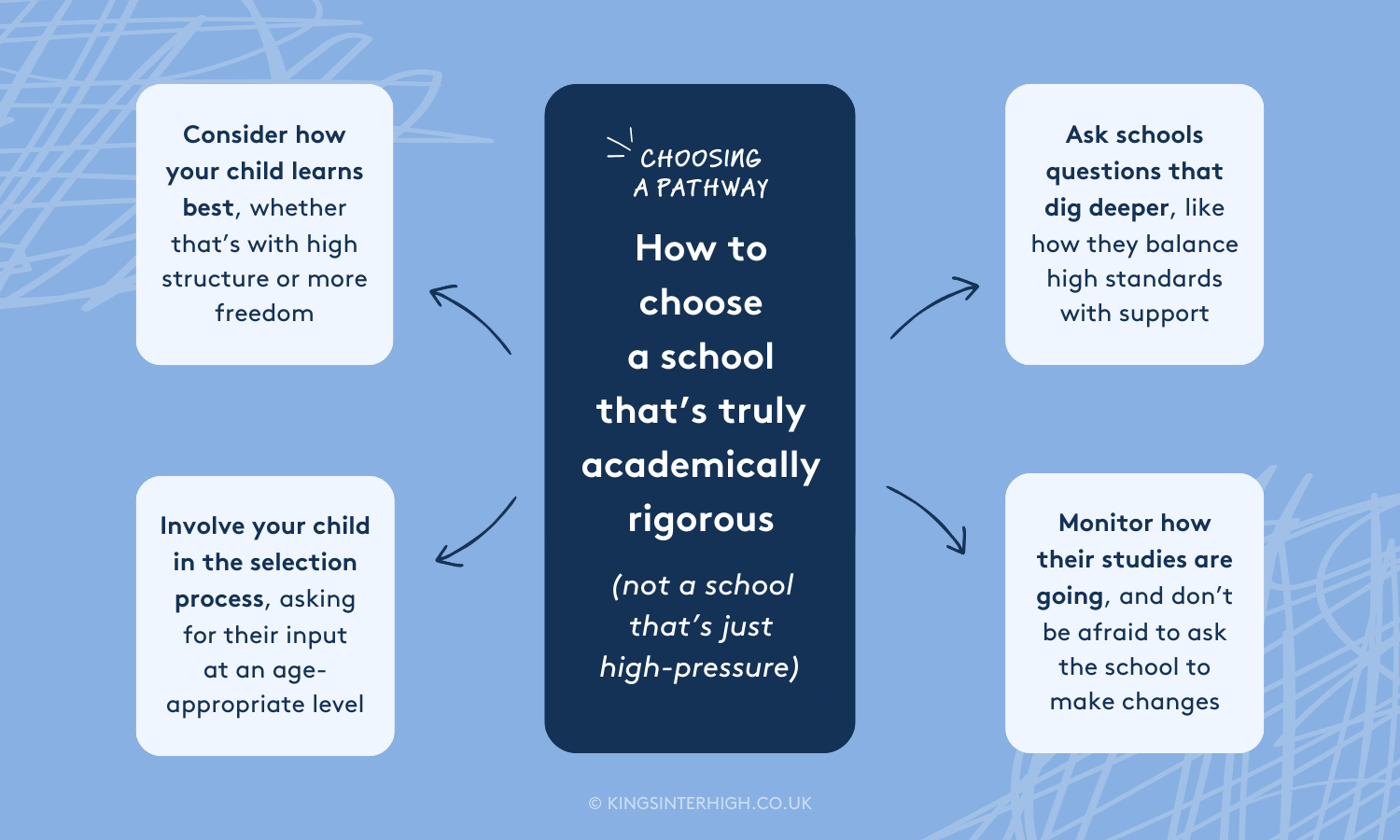
Step 1: Consider your child
The most important step in choosing a school is considering your child’s learning preferences. Do they thrive with structured guidance, or do they prefer the flexibility to explore things on their own? Do they struggle with negative feedback? Do they excel when expectations are high? Consider non-academic factors too, as school culture, friendship dynamics, and values can have a big impact on whether challenging classes feel motivating or crushing. Once you understand what your child needs, you’ll be able to assess schools based on what’s best for them, not just what’s written on a prospectus.
Step 2: Ask the right questions
When you’re looking at schools, make sure to dig deep with your questioning. Don’t be afraid to ask about emotional support, differentiation for special educational needs, and how student progress is measured beyond tests and quizzes. Ask about academic and pastoral support systems, opportunities for students who are ready for advanced work, and what successes are celebrated within the community. These are the questions that will help you truly understand what it will be like for your child to learn in their environment.
Step 3: Involve your child
Whether you’re visiting schools in person or joining online open events, try to keep your child involved at an age-appropriate level. Since young people are closer to the learning process, they often have a greater understanding of what works and what doesn’t than you may think. Ask your child whether they can see themselves learning at this school, and whether they have any reservations about potential stress, overwhelm, or boredom in the classroom.
Step 4: Monitor things over time
If you’ve chosen a school for its academic rigour only to realise it was the wrong decision, you’re not alone. Sometimes, a school that seemed great on paper may simply not be the right fit for your child. That’s why it’s important to monitor fit over time and watch out for signs of academic anxiety or disengagement. If your child isn’t growing as a learner, it may be time to talk with their teachers about how things can be adapted to work better for them.
Academic rigour shouldn’t mean academic stress
All too often, academic rigour becomes something that schools impose on students rather than shape with them. As you evaluate your options on your search for the right pathway, listen for language that makes it clear that students are heard and included in the learning process. “High standards” and “top grades” mean nothing for your child if they’re simply going to become another number. Being genuinely engaged, appropriately challenged, and excited to keep learning will go just as far in helping your child succeed, without the stress and overwhelm of a high-pressure environment.
Share: