

Article October 31, 2024
GCSE mock exams: Your guide to success

While they may not be as high-pressure as the real thing, GCSE mock exams often still feel like a big hill to climb. That being said, mocks can also be your secret weapon for success in your final end-of-year tests.
The key is knowing how to get through them successfully, from planning your revision schedule to managing exam-day nerves. Drawing on almost two decades of experience supporting thousands of our students through their mocks and to outstanding exam results, we’ve created this comprehensive guide to GCSE mock exam success.
Understanding GCSE mock exams
Ever wondered why your school makes you do mock exams? The answer is that they can be one of the most powerful tools on your GCSE journey. Let’s break down exactly what they are and why they matter so much.
What are mock exams?
Mock exams are the practice versions of your actual examinations, designed to mirror real GCSEs, A Levels, or IB Diploma exams as closely as possible. They’re typically made up of past papers or similarly formatted questions, following the same time limits and exam conditions.
Some schools schedule one set of mock exams in Year 11, while others might run multiple rounds of exams throughout Year 10 and Year 11 to give you more practice opportunities. You’ll likely cover all your GCSE subjects as part of your mock exams, giving you a complete sneak peek at what’s waiting for you in the summer.

Why are mock exams important?
Mock exams are about more than teachers just testing your knowledge. In fact, they actually have lots of benefits for you, including:
- Practice: Practice makes perfect, and mock exams give you hands-on experience in real exam conditions, taking you one step beyond normal revision.
- Time management: In particular, mock exams are an excellent way to practice how to manage your time during exams. This will be crucial, as poor time management can mean you won’t have enough time to finish all your questions — even if you know the answers.
- Confidence: Once you’ve taken your mock exams, you’ll usually feel a lot more confident about what you know and what to expect during your real GCSE tests.
- Improvement: Waiting for your mock exam grades can be a bit nerve-racking, but once you have your papers back, you’ll have a great opportunity to identify any weak areas you need to focus on before summer exams.
Succeed in your GCSE mock exams in 3 simple steps
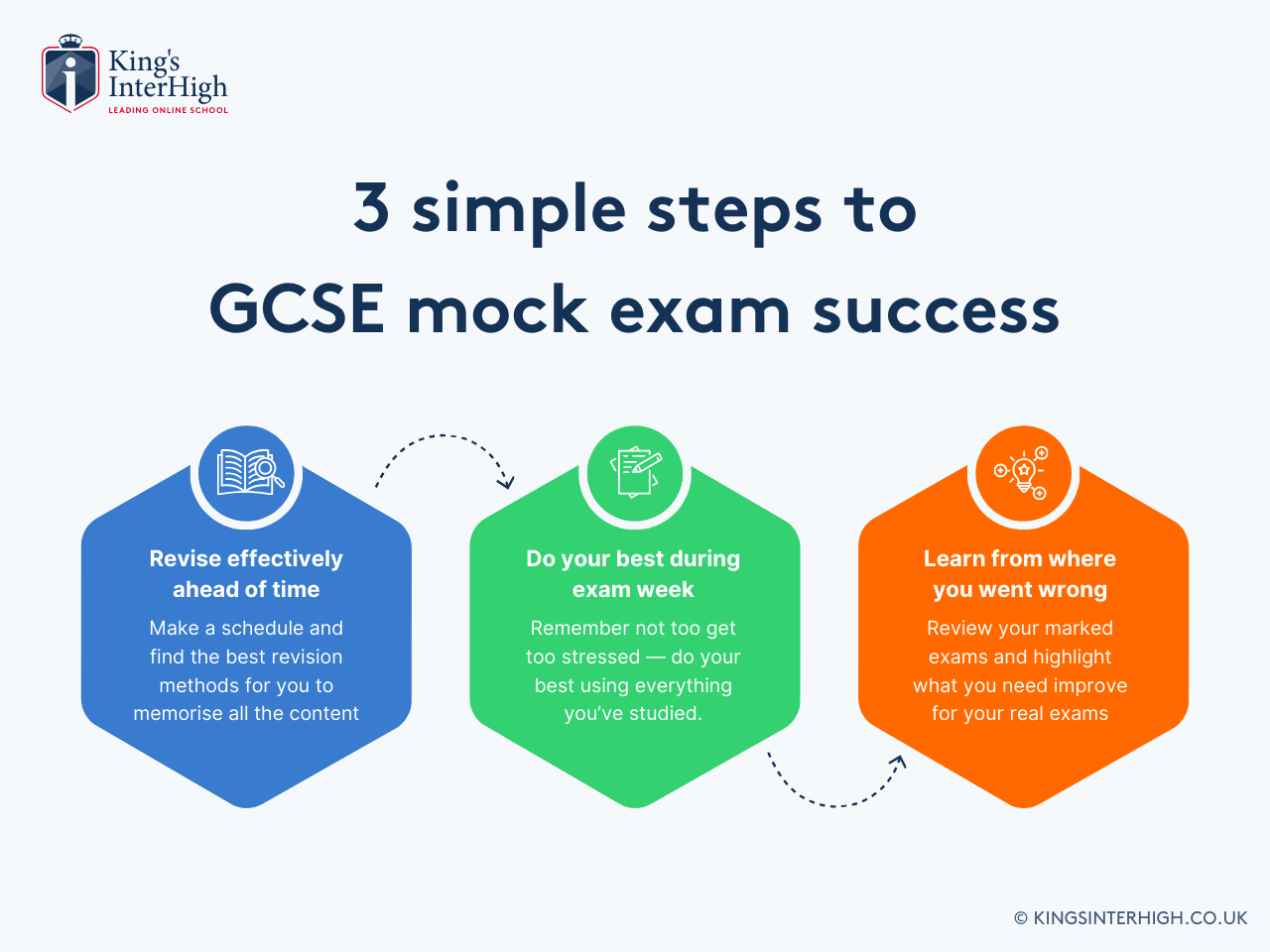
The easiest way to view your GCSE mocks is in three stages: exam revision, exam week, and post-exam improvement. Keep reading to find out how to prepare for your exams with effective revision, what to expect when you actually sit your mocks, and how to use your results to your advantage.
1. How to revise for mocks
Ideally, you’ll want to start revising for your mock exams around 1-2 months before they begin depending on how many GCSEs you’re juggling. This should give you enough time to cover everything thoroughly without burning yourself out or cramming it all in at the last minute.

Step 1: Review the specifications
Your first step is to get clear on what you need to study, so start by going through all of your subject specifications. If you don’t have copies of each syllabus already, you can find them online, but it’s also a good idea to ask your teacher. They may be able to tell you that certain topics won’t appear at all on your exam (for example, if you haven’t finished studying them in class yet). Once you’ve got the specifications, mark off topics you’re confident in and highlight areas you’re less sure of. This will help you create a revision roadmap that’s personalised to you.
Step 2: Plan your revision schedule
Our brains remember things better when they’re written down, so make sure to create an actual revision timetable (on paper or using an app) rather than “winging it.” This will also help you ensure you cover every topic and plan in enough time for breaks. Using your syllabus reviews, split the topics you need to study across the weeks ahead, giving extra time to dig deeper into subjects or areas you find challenging.
Always be realistic with your schedule; it’s important to sleep, eat, and enjoy some downtime if you want to keep up your focus and motivation. And remember, this is your personal schedule, so you can plan it around your preferences.

Step 3: Find your best revision methods
How to actually revise can often seem like a mystery, but there’s actually a lot of interesting science behind studying. For example, science says our brains usually remember more when we study actively — making flash cards, for example, rather than just re-reading notes. Researchers have also found underlying techniques that are proven to work, like:
- Retrieval: Testing your brain by trying to remember facts, which improves your memory.
- Spacing: Gradually increasing the gaps between how often you look at topics as your memory of them strengthens.
- Interleaving: Switching between different topics rather than studying one topic continuously for a long period of time.
While everyone should use these techniques, the exact methods you use to study will depend on how you like to learn and the subjects you’re taking. Here are some different approaches you can try to see what clicks for you:
- Past papers: Since mock exams are made up of past paper-style questions, using actual past papers is an incredibly effective way to study. Try doing individual questions with the mark scheme close by and completing full papers under timed conditions.
- Spaced repetition: Instead of creating paper flashcards, consider a free digital flashcard tool like Anki or Quizlet, which allows you to space out your revision and spend the most time on things you’re struggling to remember.
- Mind maps and posters: These methods are great for visual learners as well as subjects where you need to connect different concepts together, like history or biology.
- Study groups: Learning with your friends can be very helpful, as long as you don’t get distracted! Try teaching each other different topics to help you cement your own understanding — a great tool for discussion-based subjects like English literature.
Not sure where to find past papers? Check your exam board websites here:
Edexcel past papers
AQA past papers
OCR past papers
WJEC past papers
Step 4: Balance revision with rest
Perhaps most importantly, remember that effective revision isn’t about studying every minute of every day. Your brain needs regular breaks to process and memorise information, so make time to rest and recharge. Taking naps, going out for a walk, and even hobbies like video gaming can be great ways to de-stress when you’re losing motivation.

2. How to get through exam week
If you’ve revised well for your exams, the week or fortnight your mocks are held probably won’t feel as intense as you’d think! Knowing what to expect and how to get through the period smoothly will also help you make the most of your studies and get the best possible results.
Last-minute revision
While you shouldn’t leave all your revision until the last minute, it can be helpful to review key concepts and facts in the hours before a test. A good way to do this is by making flashcards of the topics you’re struggling to remember most, then going through them with friends ahead of the test. This will help you refresh your memory without raising your stress levels.
What to bring on exam day
Check with your teachers about exactly what you can and can’t bring to each exam. The rules on calculators, for example, vary between different maths papers. Once you know the restrictions, pack your bag the night before with pens, subject equipment, and a paper copy of your exam timetable (which will help you stay organised when you have multiple mocks in one day).
Managing your stress
It’s completely normal to feel some nerves before any test. Still, try to remember that you don’t need to get too anxious. Focus on self-care during your exam period (like getting enough sleep and eating properly), and if you start feeling overwhelmed, talk to your teacher or your family for advice.

3. How to learn from your results
The benefits of mock exams don’t end when you close your final paper. Alongside practicing how to answer questions under exam conditions, one of the reasons why mocks are so useful is that you can learn from your results and make improvements before your real exams.
Try not to panic
Even if you think you might not have performed your best, try not to panic. Mock exams are important, but they don’t count towards your GCSE grades. Take a deep breath when you look at your results and remember that they’re valuable information about where you are now — not a final judgement on what you can achieve.
Note your weak areas
Once you have your mock exam papers back from your teachers, go through each one carefully to look at where you lost points and why. Are there certain topics you need to spend more time on? Are there any specific patterns to note — for example, running out of time or misreading questions?
Ask for feedback
Your teachers will likely have a lot of experience in helping students improve their grades. If you’re not quite sure where you’re going wrong, don’t be afraid to ask them for feedback. They might spot things you’ve missed, or they might decide to spend more class time going over tricky topics.
Adjust your study strategies
Armed with everything you’ve learned from your mocks, refine your revision approach for the period before your summer exams. You might want to make a new list of key topics to focus on, spend more time doing past papers to manage your time, or try out different revision methods. What’s great is that now you’ll know what works for you and what doesn’t, and you’ll have a much better idea of your areas for improvement.
Going forward with confidence
Mock exams are an excellent opportunity to get experience, learn, and improve before your final GCSE exams. Taking them seriously and approaching them strategically will boost your confidence, help you find the right revision techniques, and show you exactly where to focus your efforts.
Since these tests are a stepping stone to success, remember that everyone’s path and goals look different. At King’s InterHigh, for example, our students may be balancing their studies with sports careers, working through personal difficulties like anxiety, taking exams early, or studying while travelling — all of which require a unique approach to mock exam revision.
Stay positive, keep organised, and don’t hesitate to reach out for support when you need it. With the right preparation and mindset, you’re sure to come out of your mock exams feeling accomplished.
Want a more flexible, personalised, or supportive way to take your GCSEs? Learn more about studying IGCSEs online with King’s InterHigh.
Frequently asked questions (FAQs)
When do GCSE mock exams usually happen?
Mock exams can happen at any time of year, but common times include the summer term of Year 10, the autumn term of Year 11, and the spring term of Year 11.
When are GCSE mock exams in 2024?
Your mock dates will depend on your school, so ask your teachers if you’re not sure. If you’re in Year 11 and your school is like most, however, you might take your GCSE mock exams in November 2024.
When are GCSE mock exams in 2025?
Depending on what year group you’re in, you might take your mock exams in January, June, or November 2025. Many schools hold their mock exams in different months, though, so be sure to check with your teachers to confirm the right dates.
Do mock exams count towards GCSE grades?
Mock exams are practice assessments that don’t count towards your final GCSE grades. However, your teachers may use them to predict your results or set your targets for your final exams. In the case of unforeseen external circumstances (as happened during the pandemic, for example), mock exams can also be used alongside other evidence to determine a student’s grades.
Are mock exams harder than real GCSE exams?
Mock exams are designed to replicate real GCSE exams, so they’ll usually be the same difficulty level as your final tests. That being said, if your teacher uses a past paper for your mock exam and you haven’t yet covered all the included topics in class, the mock test may feel harder than it will during summer exams.
Do GCSE mock exams matter?
While mock exam don’t count towards your final grades, they do matter. Completing your mock exams to the best of your ability will help you identify areas for improvement, practice exam techniques, and build confidence for your real GCSEs.
What happens if you miss a mock exam?
Unlike a real exam, if you miss a mock exam due to illness or another valid reason, your school may be able to arrange for you to take it at another time. Always inform your school as soon as possible if you can't attend a mock exam.
What happens if you fail a mock exam?
Getting a lower grade than you expected on a mock exam isn’t the end of the world. In fact, it’s a valuable opportunity to see which topics or question types you need more practice with before you take your real GCSEs. If you do get a “fail” grade on your exam, or a lower grade than you were predicted, your teacher may want to talk to you to understand where things went wrong and how you can improve for next time.
Share: