
Article October 17, 2025
Getting your anxious students back to campus life with online learning

With one in seven young people worldwide experiencing mental health conditions according to the World Health Organization (WHO), student wellbeing has never been more crucial. For many international schools, it has also never been more complex.
ISC Research’s pandemic report on wellbeing in international schools found that teachers’ pride in the wellbeing support they provided dropped 11% from 2018 to 2021. While the eventual return to in-person schooling was a welcome change that saw many students feeling better, the pandemic also triggered a rise in mental health conditions that didn’t necessarily end when lockdown did.
Anxiety and depression rose by 25% worldwide, with rates of social anxiety and agoraphobia climbing among adults and young people alike. For many schools, this presents a difficult challenge: even with excellent pastoral care in place, sometimes the very act of coming to school is the problem.
That being said, it’s not a challenge without a solution. In fact, one of the most effective strategies for getting students’ mental health and school journey back on track is also one of the easiest to implement: hybrid learning.
There are numerous benefits to adding remote learning options to your school through an experienced online teaching provider like King’s InterHigh. Alongside bridging your recruitment gaps or expanding your curriculum, online learning can also offer your students a supported pathway to temporarily step back without falling behind. It’s not just a way to maintain academic progress — it’s a way to give students the space they need to rebuild their wellbeing and a seamless bridge back to campus life.
Hidden costs and support gaps
When a student has trouble with their mental health, the ripple effect can extend from their individual wellbeing all the way through your school. While each student’s personal wellbeing needs are always the prime concern for any school, mental health struggles can also have knock-on effects for your community and administration.
With conditions like anxiety, depression, and school-related phobias, academic performance can fall fast. When students are in class, they’ll likely find it difficult to focus, participate, and keep up with coursework. In severe cases, attendance can also suffer when students find it increasingly difficult just to walk through the school gates.
Worse still, this creates a difficult cycle: the more a student falls behind, the more anxious they’re likely to feel. Social connections can suffer too, with mounting pressures leading students to withdraw from school life. Community is a crucial element of the experience at any international school, and losing contact with friends can be just as difficult for classmates as it can be for the individual student suffering from anxiety.
In turn, the more students struggle, the more academic performance and future prospects fall schoolwide. Some parents will become increasingly concerned and even frustrated about their child’s school progress, while others may even choose to withdraw their child from school entirely to tackle the problem. What may start out small can soon have sprawling effects for all parties involved.
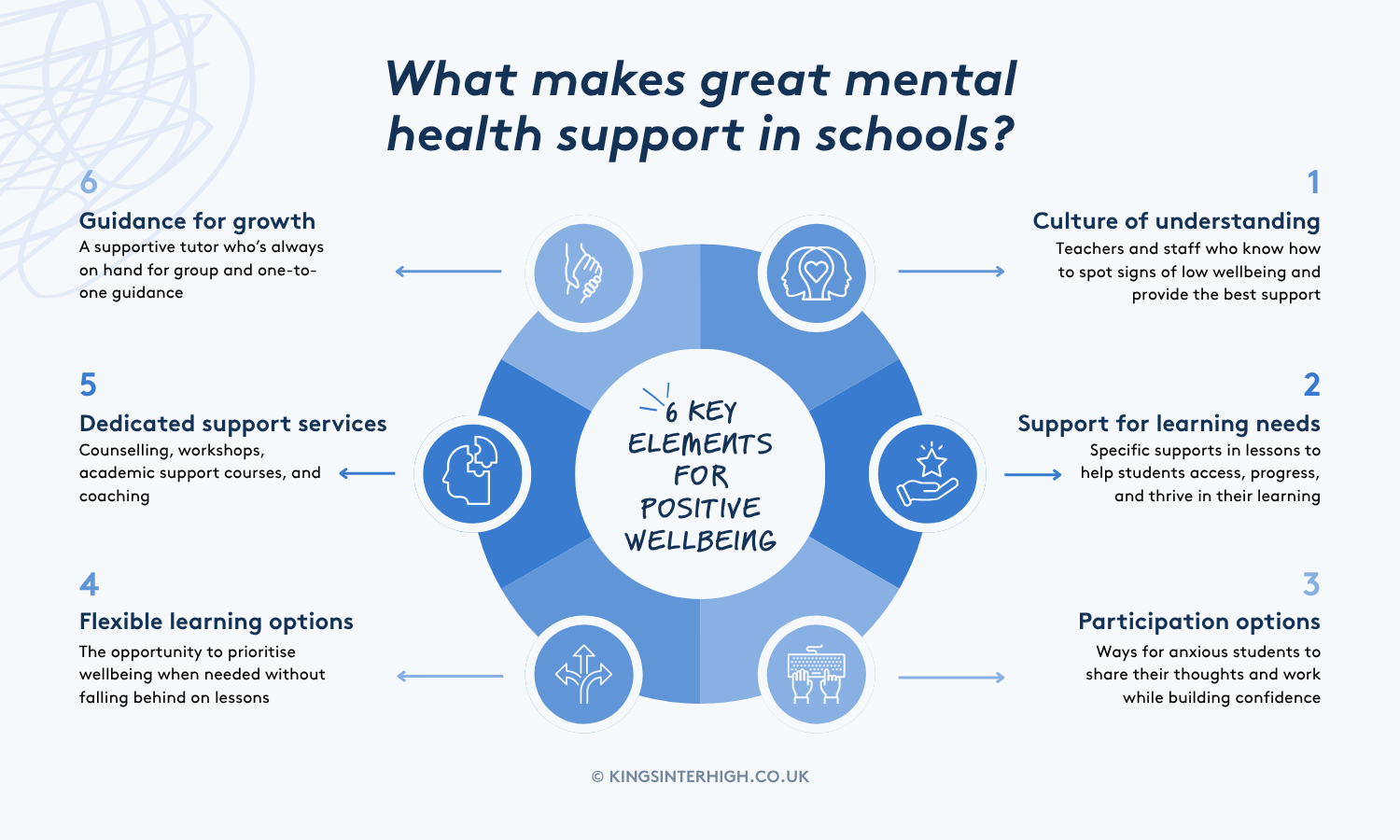
At its core, the problem is that even the most robust pastoral system won’t necessarily be a match for acute mental health needs. School counsellors, wellbeing workshops, and awareness initiatives are incredible ways of addressing the typical worries and difficulties young people face, but strong in-school support still has its limitations.
The reality is that some students will only be able to get better with time away from the school environment and access to dedicated psychiatric or specialist help. However, that doesn’t mean you need to say goodbye to students or watch them suffer in silence. Remote learning is a flexible solution that can provide a pathway for students to rebuild their wellbeing and work their way back to in-person classes as quickly and seamlessly as possible.

Online learning: A bridge to recovery
As more and more forward-thinking schools employ a hybrid model for future success, you may have already considered implementing your own online arm. Schools around the world have long been partnering with King’s InterHigh for a vast array of initiatives — like the British International School in Ukraine, for example, who used King’s InterHigh’s expert online teachers to broaden their A Level offering with new subjects online.
The use cases, however, are wider ranging than you may think. Once you’ve implemented remote learning opportunities into your school, you can make use of them in a whole host of situations, including as a tool for student mental health.
Previously, if a student wanted to dedicate adequate time to mental health recovery (with professional appointments, for example, or therapeutic programmes), they’d have to take time off school to commit to them. As a result, they’d face the risk of significant learning loss and a noticeable drop in grades. At the same time, when said student is at school, they’re not getting the space they need to reset and work on the positive strategies and routines that will get them feeling happy in class again.
On the other hand, when you employ hybrid learning at your school, students who need respite can take their lessons online. King’s InterHigh’s bespoke solutions can be set up to integrate with your school’s provision, allowing students to seamlessly transition into the same subjects you teach on a tailored timetable that works alongside your in-person offering.
These students then get to keep up with their learning from the comfort of home, creating the breathing space they need for successful recovery. With qualified, expert online teachers, you can rest assured knowing that your young people are getting the same calibre of academics you offer, just in a way that best suits them.
King’s InterHigh classes are delivered live and interactive, but if students are having a difficult day or need to attend an appointment, they can catch up with lesson recordings available 24/7. Rather than having students completely disconnect from education during their recovery period, schools get a unique opportunity to maintain their progress and a sense of community. The online environment itself can even be a big boost in rebuilding confidence, as students who struggle with social anxiety often find it easier to start participating again with virtual classroom tools.
Then, as their mental health starts to improve, students can make a staged move back to face-to-face learning on your campus. The goal isn’t to keep students learning remotely indefinitely, but to provide a supportive bridge back to school life. Your learners are free to make a jump right back into classes, build up from attending one or two days a week, or even make the transition gradual by taking some online lessons on your school campus. Schools are free to tailor each student’s phased approach to their needs, which can lead to far more successful reintegration than an all-or-nothing return.
The power of flexible learning
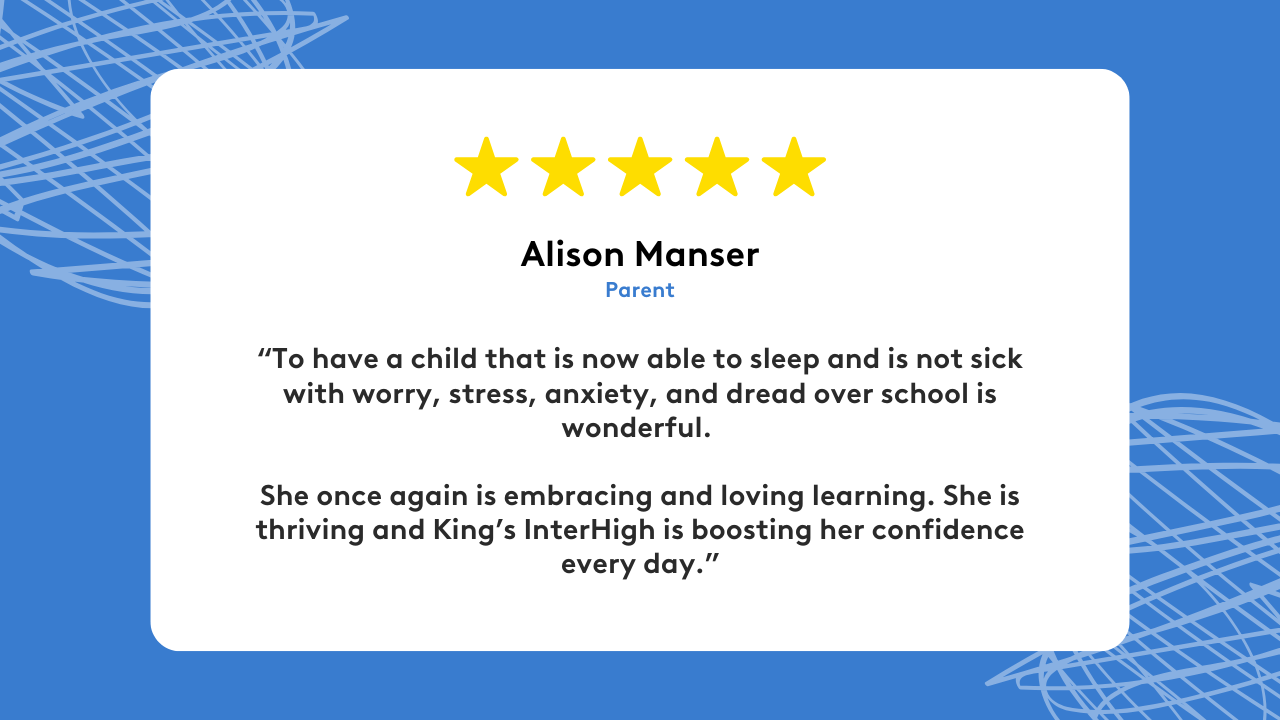
For over 20 years, King’s InterHigh has been supporting students around the world with mental health struggles that can show up in any international school community. “What’s great about virtual learning is how it maintains the structure and engagement of school, but in an environment where students feel calm and in control,” says King’s InterHigh’s Head of SEN, Ray Boxall. “Time and time again, we’ve found that this is the perfect balance for young people struggling with their mental health and a successful stepping stone to thriving at school in person again.“
Take teen student Tabatha, for example, who found that online learning with King’s InterHigh was the perfect reprieve she needed from social difficulties that impacted her wellbeing. Alongside academic continuity, studying remotely gave her the space to rebuild her confidence and explore activities that helped her relax and recover, like crocheting. That flexibility created a pathway that saw Tabatha go on to achieve top grades in her IGCSEs and take on her A Levels on campus with enthusiasm. Today, she plays handball with her school, winning the Women’s Handball Premier League earlier this year.
Stories like Tabatha’s highlight just how powerful online learning can be in creating a stepping stone. Removing the immediate pressures of the classroom while maintaining the structure and standards your school upholds means your students can focus on their recovery without sacrificing their education. As they swiftly work their way back to class, they get access to outstanding teaching in state-of-the-art virtual environments. And, all the while, they remain part of your school community, ready to soon rejoin their classmates.
Virtual learning that works for your school
The key for international school success increasingly leans toward flexibility. The ability to adapt to the needs of your students, staff, and administration as a whole is what will set your school apart and prepare you to weather any difficulties that may come your way.
Creating your own hybrid learning from scratch can be costly, risky, and time-consuming, but partnering with an existing expert provider gives you all the benefits with swift, seamless, bespoke implementation. Whether you need a structured pathway for students who need time away from campus or a safety net that’s there when you need it, King’s InterHigh can work with you to set up remote learning that works for your school and your students.
Share: