

Article January 30, 2026
5 schooling options to consider beyond mainstream education
If mainstream education isn’t working for your family, choosing an alternative pathway doesn’t mean you have to compromise on school quality, your child’s learning experience, or their future prospects.
Today, there are numerous schooling options available to suit a vast range of needs, from flexible online learning to approaches like Montessori and Steiner. In the UK alone, hundreds of thousands of children study outside the mainstream state school system. About 600,000 are privately educated, and more than 175,000 were home educated in 2024-25.
Why explore alternative schooling options?
Across the UK and worldwide, more and more families are questioning whether mainstream school is the best fit. While many students thrive in traditional state schools, one size doesn’t fit all when it comes to education.
Some of the most common reasons today’s parents are looking into alternative schooling options include:
- The need for a different learning environment: For children who are neurodivergent, experience anxiety or sensory sensitivities, or have other mental or physical health needs, traditional classrooms can be overwhelming. This sometimes even leads to emotionally based school avoidance (EBSA).
- Lifestyle and practical considerations: Children who travel frequently with their families or are pursuing careers like elite sports and performing arts often need more flexibility than mainstream schools can provide.
- A desire for modern learning: Increasingly, many parents want a forward-thinking approach to education, whether that’s in the form of more personalisation, more innovative teaching, more focus on digital literacy, or more alignment with values like global citizenship.
- Changing perceptions post-pandemic: Remote learning showed families that education doesn’t have to happen in a physical classroom, leading to a rise in home education and online schooling for children who thrive with more control over their environment.
Thankfully, there are numerous schooling options available in today’s educational landscape, and each one suits different wants and needs.
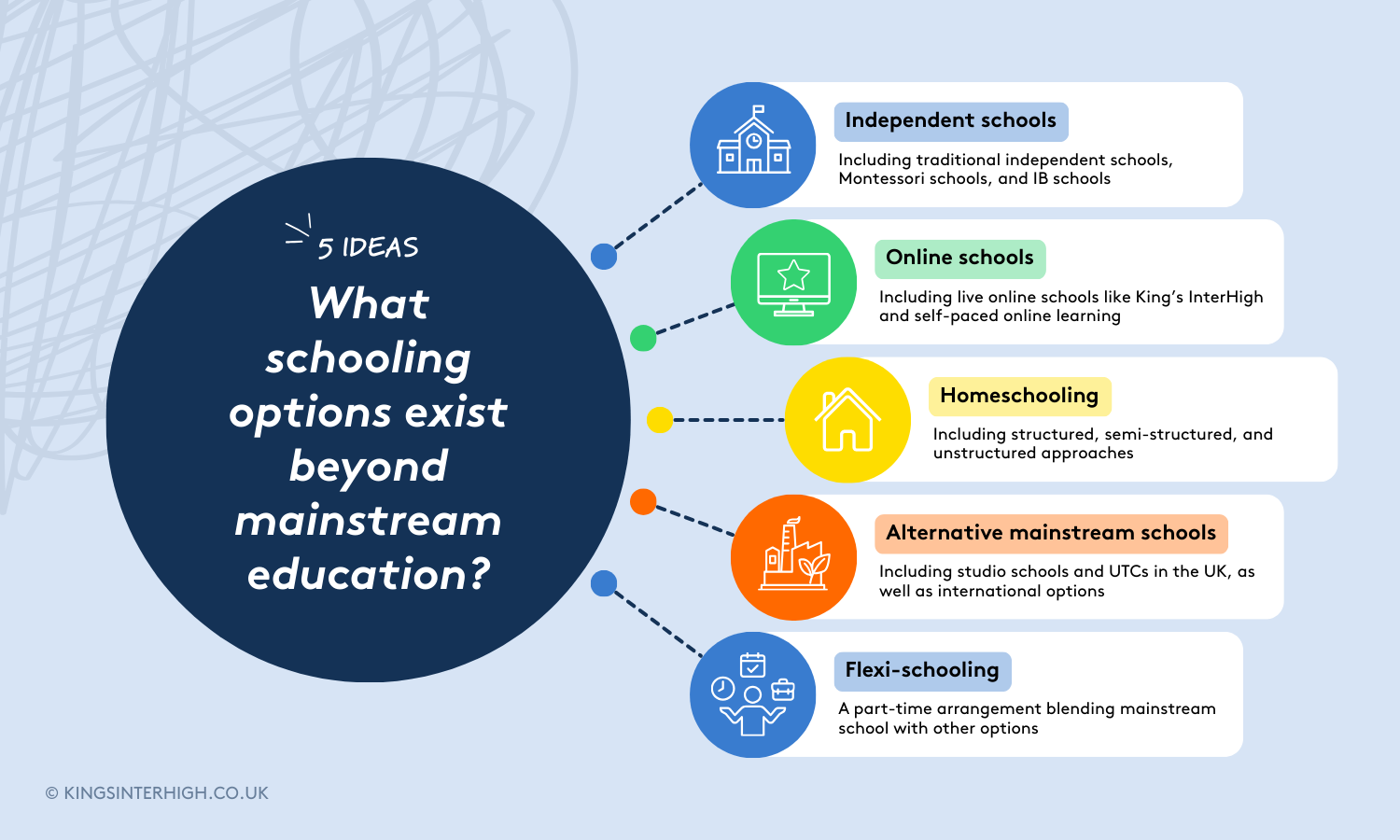
Option 1: Independent schooling
Independent schools (or private schools) are privately funded through tuition fees, giving them more autonomy over curriculum, admissions, and management than government-funded state schools. In the UK, independent schools don’t have to follow the national curriculum, which has given rise to a diverse range of options.
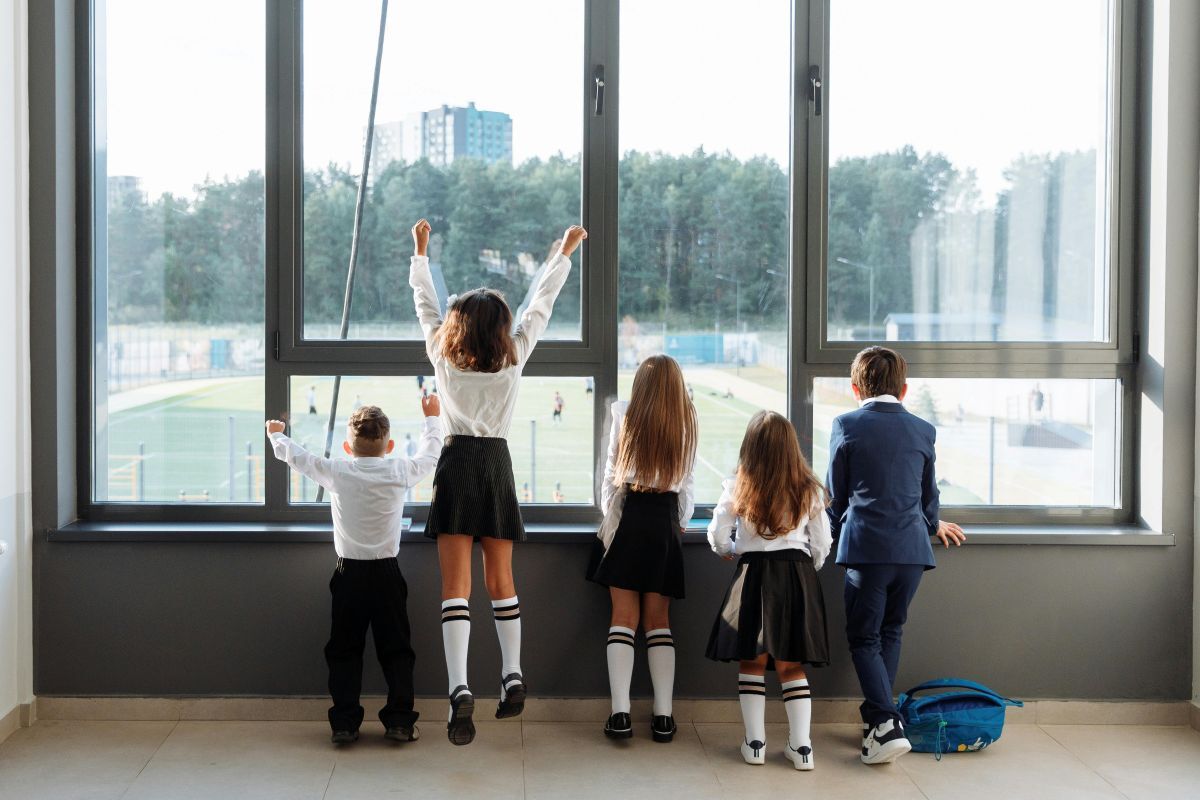
Traditional independent schools
Many independent schools follow a similar traditional model to mainstream schools. They keep a structured, academic focus and teach the national curriculum, including GCSEs and A Levels. However, they may have advantages over some mainstream schools, like smaller class sizes, more specialist facilities, the opportunity for boarding, or a greater emphasis on extracurriculars like music and sport.
Alternative independent schools
On the other side of the independent school landscape, there are several distinct educational models to choose from, including:
- Montessori schools: Montessori is based on child-led learning, where students develop independence and curiosity at their own pace through carefully designed activities. This is more commonly found at primary level in the UK, with families transitioning to different approaches for secondary school.
- Steiner or Waldorf schools: Steiner education, also known as Waldorf education, emphasises imagination, creativity, and holistic development. The curriculum often includes activities like arts and outdoor learning, and there’s usually less focus on exams and grade outcomes.
- Reggio Emilia schools: Reggio Emilia views children as capable, curious learners who build knowledge best through exploration and relationships. Learning happens through long-term projects driven by children’s interests, and the approach is most often found in nurseries and early years settings in the UK.
- International Baccalaureate (IB) schools: While there are several state schools in the UK teaching IB programmes, most IB schools are independent. The International Baccalaureate (which includes the popular IB Diploma Programme) is known for its globally minded, well-rounded approach.
While independent schools can offer richer, more student-centred learning, high tuition fees and location can be barriers. If you choose an approach like Montessori for primary school, you’ll also need to consider how your child will transition to a secondary school pathway and prepare for university if desired.
Option 2: Online schooling
Of course, education doesn’t have to be brick-and-mortar. Online schools have become a popular alternative to mainstream learning over the past few decades, with more than 600,000 online school students in the US alone. Each type of online school works in its own way, so the key to finding the right fit is understanding the differences.

Live online schooling
Online schools like King’s InterHigh combine the benefits of live, traditional teaching with the unique advantages of the virtual environment. At King’s InterHigh, students follow a weekly timetable, logging on for interactive lessons with expert teachers and global classmates each day. Children can also make friends through online clubs, in-person meetups, and more. But, unlike mainstream state school, class sizes are small and families have the flexibility to study anytime, anywhere, with a highly personalised and supportive approach.
Self-paced online schooling
With asynchronous learning, students access course materials (like pre-recorded classes and online textbooks) and complete assignments at their own pace. There’s typically less interaction than a live online school, but also a high degree of flexibility. At our fellow Inspired Online School, USPA, for example, elite athletes can complete their schoolwork while travelling and training, with the support of a learning coach to coordinate their studies.
Online homeschooling
There are also online homeschool services, which provide curriculum resources and materials that parents can use to structure learning at home. Think of it as a middle ground between home education and an online school. Students get access to learning materials and sometimes tutor support, but without set courses, mandatory grading, or peer interaction.
There are also some schools that blend online and in-person education, known as hybrid learning. Many schools work with us at King’s InterHigh, for example, to expand their traditional education approaches with live, virtual teaching.
Option 3: Homeschooling
Outside of teacher-led schooling options, home education remains a popular choice.
Sometimes called elective home education or EHE in the UK, homeschooling sees parents take full responsibility for their child’s education. It’s legal in the UK with no permission or teaching qualifications required, though parents must provide education suitable to their child’s age and ability as outlined in the GOV.UK guidance. Most families choose homeschooling for its flexibility and personalisation, with three broad styles to choose from: structured, semi-structured, or unstructured.
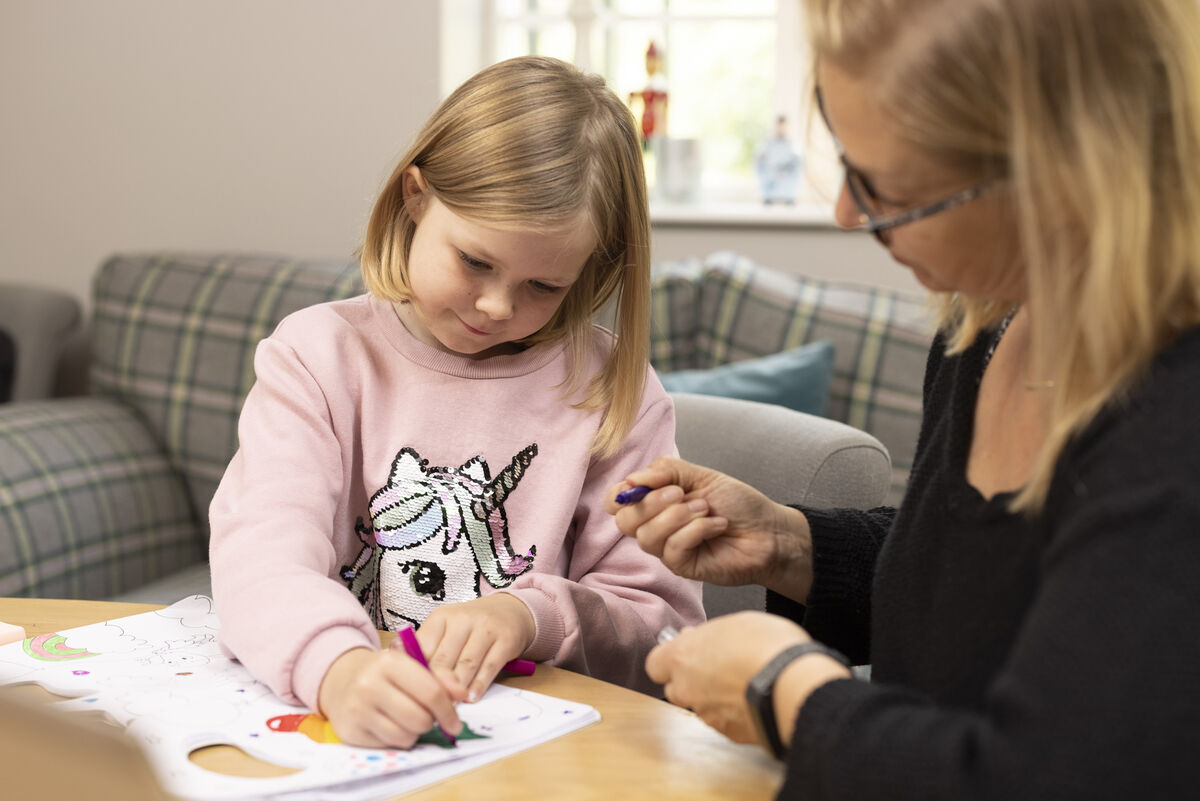
Traditional homeschooling
This approach replicates a school environment at home, with parents delivering lessons on a daily schedule using textbooks or workbooks aligned to the national curriculum. It provides clear structure, but it does require significant time and confidence.
Curriculum subscription services
These pre-packaged programmes (which sometimes brand themselves as online homeschools) offer lesson plans, videos, and assessments that parents follow at home. While parents still deliver and supervise learning, subscriptions remove much of the planning pressure.
Online home education
Alongside online homeschools, families can also use live online schools like King’s InterHigh as part of a home education programme to blend expert teaching with flexibility and autonomy. Our Academic Accelerator programme, for example, lets secondary students aged 11–16 study up to three subjects with King’s InterHigh.
Specific pedagogical approaches
Alternative methods like Montessori and Waldorf aren’t exclusive to physical schools. The Charlotte Mason method (focusing on short lessons, nature study, and holistic development) is also particularly popular among homeschooling families.
Unschooling
This interest-led, child-driven approach has no set lessons or curriculum. Children learn through play, exploration, and curiosity. Some parents choose unschooling to rebuild a love of learning after difficult school experiences, though the lack of structure can be challenging for families focused on exams and higher education.
There’s no one exact way to home educate a child, which is why many families mix and match with an eclectic approach. Blending curriculum resources, child-led projects, and different ideas about learning, parents can tailor their child’s education as they grow.
Option 4: Alternative state schooling
While most state-funded schools in the UK follow a traditional, mainstream model, there are some options for vocational or specialist teaching designed to prepare students for specific careers or industries.
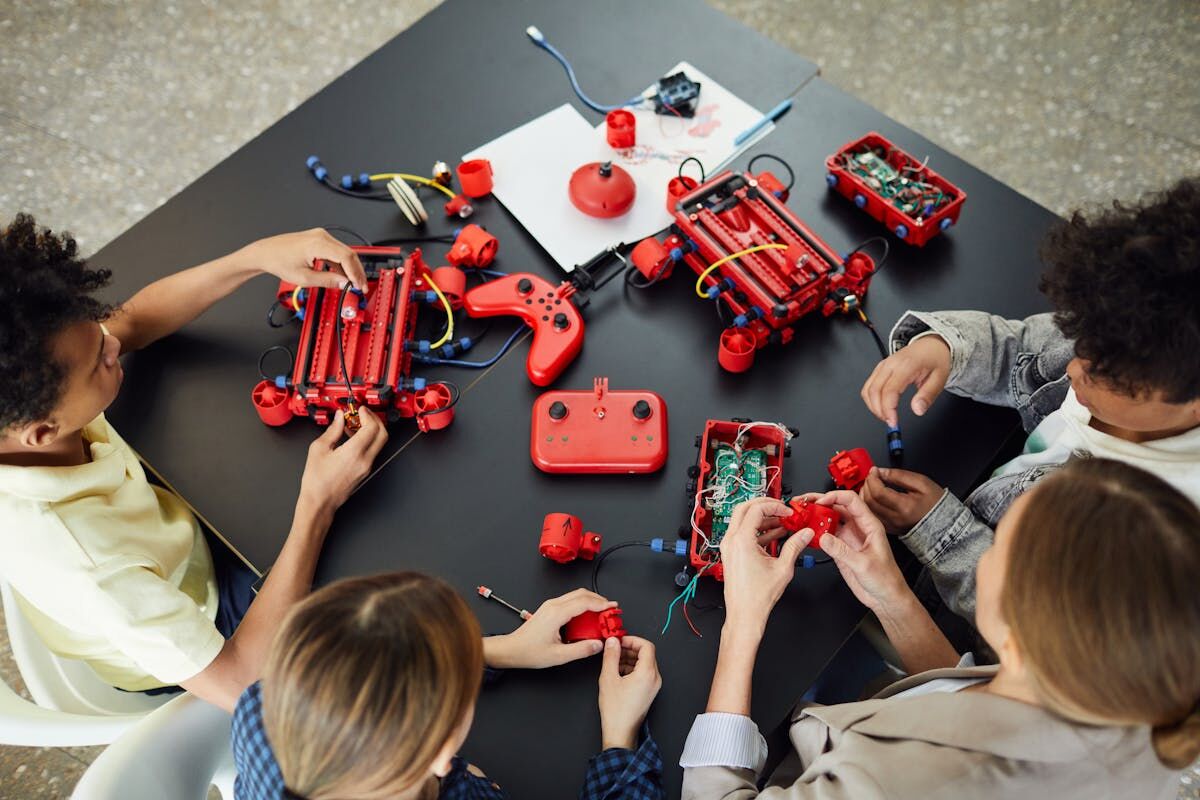
Studio schools
Introduced in 2010, studio schools are small state schools (typically a few hundred students aged 14–19) that blend academic study with practical, work-based learning. Students work on real projects with local employers in sectors like engineering, health, or creative industries while earning GCSEs, A Levels, or BTECs.
University Technical Colleges (UTCs)
UTCs are also state-funded schools for 14–19-year-olds, but they focus on technical subjects like engineering, computing, or life sciences. Backed by universities and employers, they offer cutting-edge facilities and industry placements to prepare students for apprenticeships or STEM-focused university courses.
International state alternatives
Many countries have their own publicly funded alternatives too. In the US, magnet schools offer specialised programmes in STEM, arts, or languages, while charter schools operate with more flexibility than traditional public schools.
Option 5: Part-time schooling
Some students thrive with many aspects of mainstream schooling but still need more flexibility or support. For these families, a middle ground between full-time school and alternative learning works best. This is typically referred to as flexi-schooling in the UK.

Flexi-schooling
With flexi-schooling, children attend school for some sessions and are home educated the rest of the week. For example, a child might attend from Monday to Wednesday, then learn at home on Thursday and Friday. This suits children who find full-time school overwhelming due to anxiety, sensory sensitivities, or fatigue, but it’s important to note that flexi-schooling isn’t a legal right. Families must get their school’s agreement to begin a part-time arrangement.
Pros and cons: Weighing up your schooling options
With so many schooling options available, it can feel overwhelming to work out which one truly fits your family’s needs. Each option comes with different trade-offs in terms of cost, flexibility, and involvement required from parents.
| Independent schools | Online schools | Home education | Studio schools and UTCs | Flexi-schooling | |
|---|---|---|---|---|---|
| Cost | High fees, often £10,000–40,000+ per year | Moderate fees, starting from £4,040 per year at King’s InterHigh | Typically free or low-cost | Free (state-funded) | Free for the mainstream school portion |
| Flexibility | Fixed term times and timetables | Flexible timetables and learning from anywhere | Complete flexibility according to the family’s preferences | Fixed term times and timetables, sometimes 9–5 | Moderate flexibility depending on school agreement |
| Parental involvement | Low day-to-day involvement with parents supporting homework | Minimal involvement for older children with school handling teaching | Very high parent involvement with parents managing entire education | Low day to day involvement with school managing education and work experience | A blend of low parental involvement on school days and high involvement on home days |
| Structure and teaching | Structured with in-person lessons and qualified teachers | Structured with live online lessons and qualified teachers at King’s InterHigh | Varies widely; can be structured, semi-structured, or completely child-led | Practical, project-based learning with employer partnerships and qualified teachers | Split between school structure and home approach; requires coordination |
| Qualifications | GCSEs, A Levels, IB, or alternative qualifications depending on school | IGCSEs, A Levels, and IB Diploma Programme at King’s InterHigh | Any qualifications families arrange with external exam centres | GCSEs, A Levels, BTECs, and other technical or vocational qualifications | Depends on school; typically follows school’s qualification route |
| Availability | Limited by geography and admissions; waiting lists common | Fully accessible from anywhere worldwide at King’s InterHigh | Available to all families in the UK; legal right with no permission needed | Very limited; fewer than 50 UTCs and studio schools across England | Depends entirely on individual school agreement |
Choose the right pathway
Whether you go online, independent, or anywhere in between, making the move to a new school can give your child something invaluable: an education that truly fits their needs, improves their daily life, and sets them on a path to their dreams.
Take the time to explore your options, listen to families who made the same choice, and trust that prioritising your child’s needs, interests, and goals is the right move. A better path is out there for your family.
Share: