
Article May 5, 2025
How do you revise for maths GCSE, A Level, and IB exams? Your ultimate guide to success

With exams fast approaching, King's InterHigh's Head of Maths, Elizabeth Kendrick, shares her expert insights on how to revise for mathematics success.
As the summer exam season approaches, students and parents alike are gearing up for this year’s upcoming mathematics exams.
At King’s InterHigh, we understand the importance of thorough preparation and effective revision strategies, and we’re dedicated to providing students with the resources and support they need to excel in their exams.
With 20 years’ expertise in online schooling, we have lots of experience guiding young people with a wide range of grade targets and learning styles. In this article, I’m here to guide you through the essential steps to preparing for maths exams, giving you the confidence and skills to succeed.

Where to start with maths revision
How do you revise for a maths GCSE, A Level, or IB Diploma exam? At King’s InterHigh, the first step in your revision journey will be to enrol in our Revision courses. These courses are designed to provide you with comprehensive resources and guidance tailored to the curricula. Offering structured content and practice materials to reinforce your understanding of key concepts, Revision courses will serve as a great starting point.
King’s InterHigh students can find details on how to enrol in a Revision course through the Student Hub, or by speaking to their Explore teacher for maths.
For students who aren’t learning online, the best first step is similar: gather together all the materials you might need for your exams. This includes finding all your maths exercise books and worksheets from the year, bookmarking your exam specification online, and making note of any other tools or resources you want to use.
Essential maths revision materials
To make sure you’re covering all the maths topics you need to revise efficiently and comprehensively, you’ll likely want to make use of a variety of different materials. Over the years, we’ve found that these are the best three to have on hand, all of which we offer on our own mathematics Revision courses:
1. A variety of revision materials
This includes a variety of study materials, including notes, videos, and interactive exercises. Using different types of materials — visual and text, passive and active — is a great way to reinforce your understanding of mathematical concepts.
2. Past exam papers
Practising with past exam papers will help you familiarise yourself with the format and types of questions you may encounter. The more past questions you answer, the more you’ll build confidence and improve your time management skills for the actual exam.
We provide students with all past paper answers and some worked solutions to guide them through exactly what is required for answering exam questions successfully. If you’re studying at a school that doesn’t provide past papers, you’ll often find answer keys and sample answers online.
3. Additional online resources
Ask your maths teacher which online resources they recommend for studying. Dedicated tools and platforms can be a big help in supporting your revision in the lead-up to exams.
In addition to our Revision courses, for example, King’s InterHigh offers a range of other resources to support learning:
- Inspired AI: Our AI-powered pathways that bring you content and activities tailored to your unique strengths and areas for improvement in maths.
- An interactive maths lesson platform with exercises that reinforce your understanding of key concepts.
- A video-based maths support website that provides worked solutions.
These resources are designed to complement our students’ revision efforts and provide additional support where needed.

Key topics for revision
To maximise your revision efforts, focus on the key topics that are likely to appear in your exams. It’s really important to understand which topics will be on which papers so that your revision is targeted. You can find this information from your teachers or in your exam specification document.
For International GCSE Maths and Further Maths, for example, any topic can be on either of the two papers. With A Level Maths and International Baccalaureate Maths exams, on the other hand, the questions and question types vary by paper. Concentrating on the areas you’ll need for your next exam paper will ensure that you cover the most important content and are well-prepared for any question that may arise. And, if you’re sitting resits, make sure you double check you’re using the specification for the right year.
How to revise for maths GCSEs, A Levels, and IBDP
There are so many study methods you can use to revise for your exams (and mock exams), so it’s good to try out a range of techniques to find the ones that work best for you. These are some of the methods we recommend for our students at King’s InterHigh.
Practise with past papers
One of the most effective ways to prepare for your exams is by practising with past papers. Our Revision courses provide access to a range of past papers, complete with worked solutions and mark schemes.
This allows you to:
- Familiarise yourself with the exam format: Try to understand the structure and style of questions you will encounter, so you know how to earn the most marks.
- Identify weak areas: Highlight the questions you find challenging and focus your revision on these topics.
- Improve your time management: Practise completing papers within the allotted time to enhance your exam performance.
Learn by doing
Mathematics is a subject best learned through practise. While videos and worked solutions are helpful, it’s crucial to ensure you can solve problems independently.
For example, we encourage active learning on our Revision courses by providing opportunities to work through problems and check your solutions. Remember, there are no shortcuts to success — consistent practise is key.
Maths IGCSE, A Level, and IB exam dates
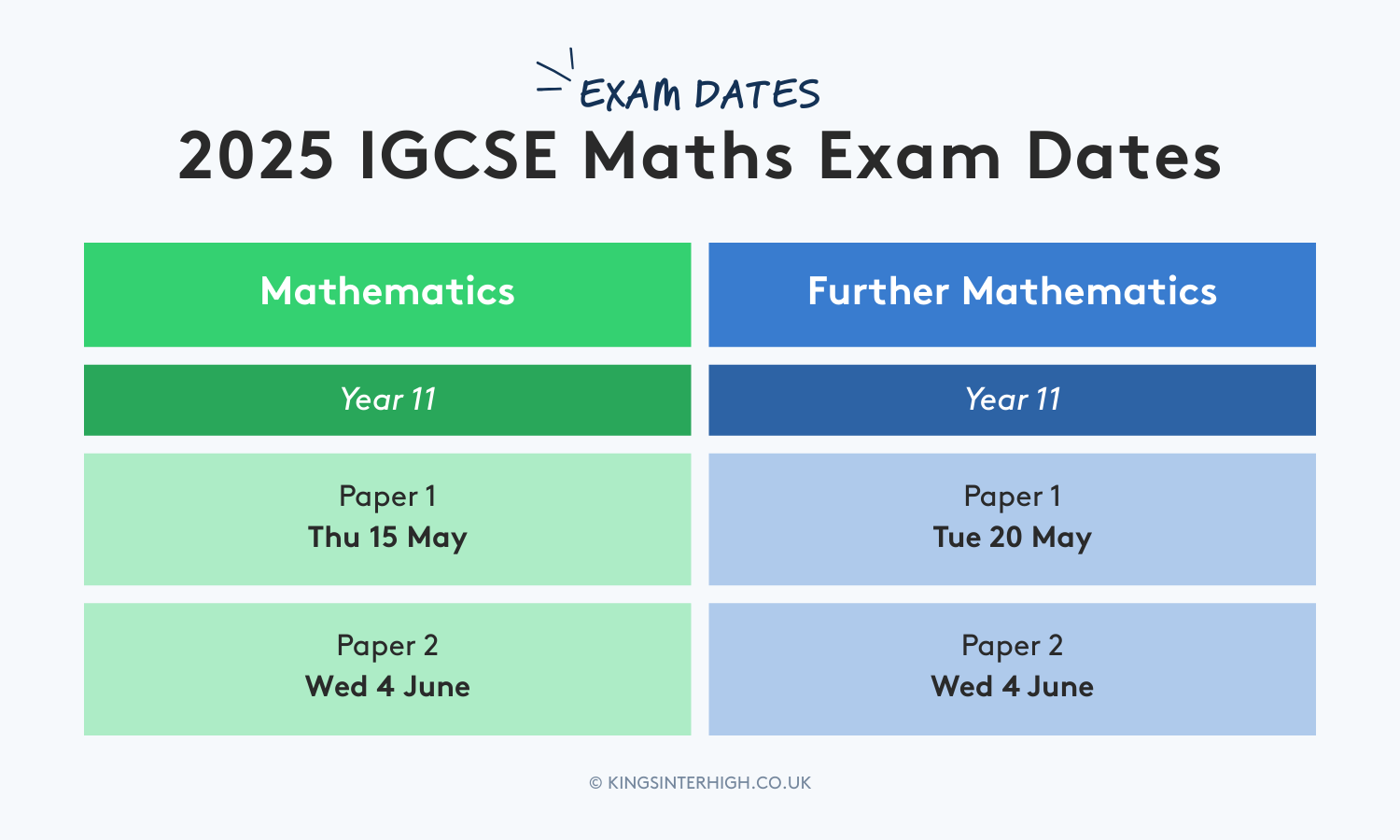
As you prepare for your exams, it’s essential to be aware of the exam dates and ensure you have all the necessary equipment. Being prepared in advance helps you balance your maths revision with study for other subjects, which reduces the risk of you becoming overwhelmed.
Here are the dates for International GCSE Mathematics exams in 2025:
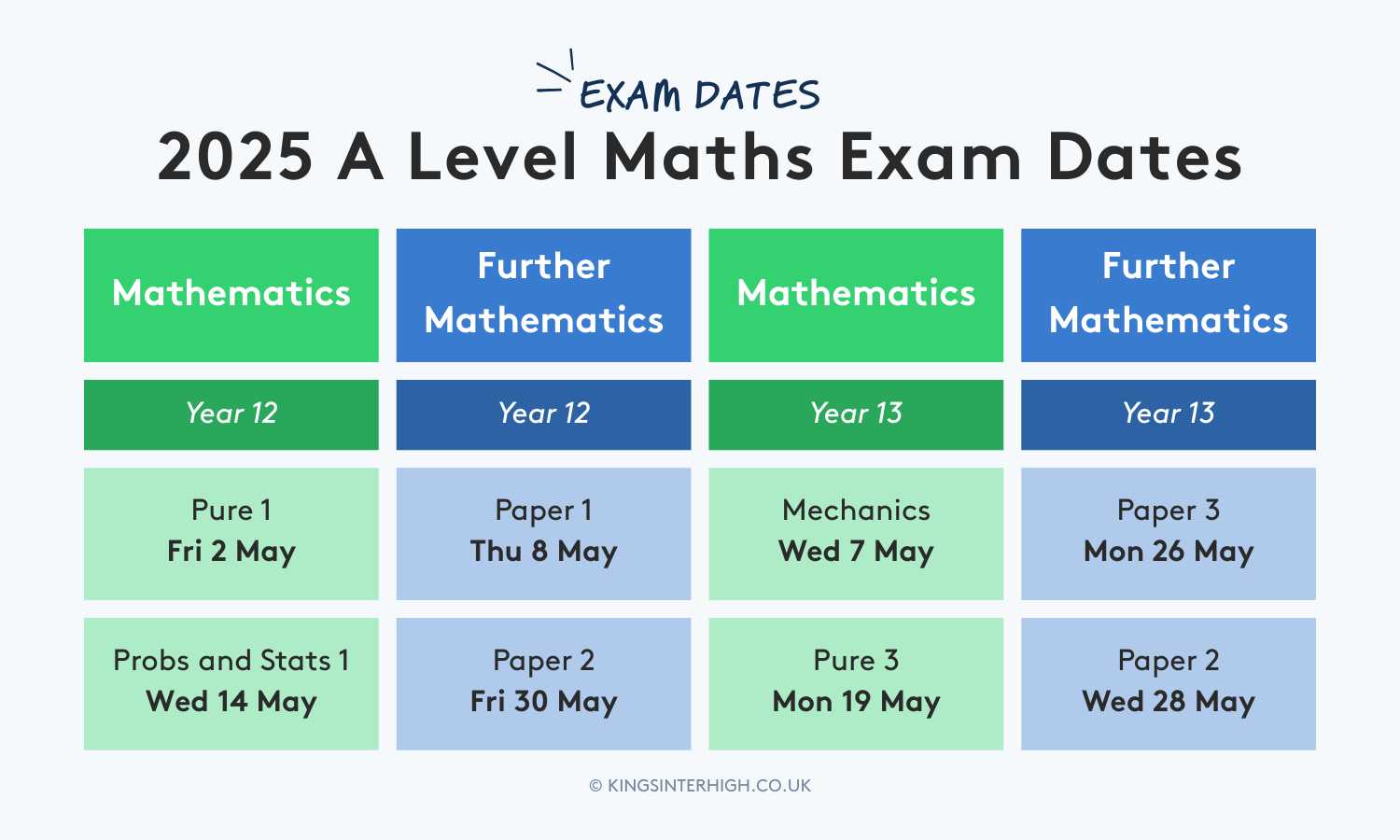
Here are the dates for A Level Mathematics exams in 2025:
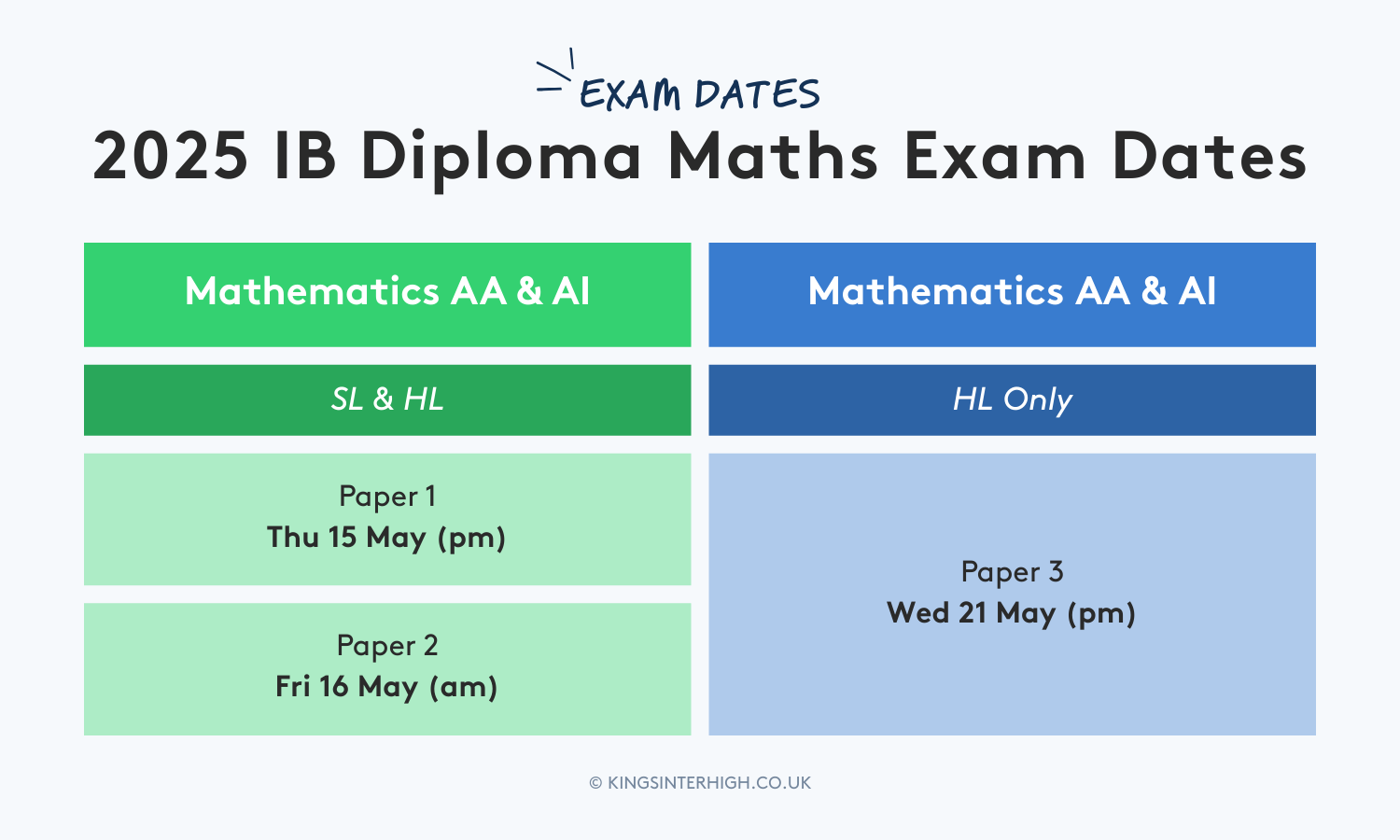
And here are the dates for IB Diploma Mathematics exams in 2025:
What to expect in your exam
On the day of the exam, we recommend following these steps to maximise your performance:
- Make sure you’re ready with plenty of time: Whether you are sitting your exams online from home with King’s InterHigh, in a room at your school, or you’re travelling to an exam centre, you don’t want to have to rush. Plan your travel ahead of the exam date, and if you’re taking your exam online, make sure your login details work and the software has been trialled.
- Read all the exam questions: Once your exam begins, make sure you carefully read each question to understand what is being asked. The last thing you want is to lose marks solely because you misunderstood the question.
- Prioritise questions: Identify the questions you can solve easily and those that may be more challenging. Then, start by answering the questions you are confident about and show all your working out. You then have more uninterrupted time to tackle the more challenging questions. Remember — even partial answers can still earn marks.
- Check your work: Finally, try to leave some time at the end of the exam to review your answers to ensure accuracy and completeness. You may spot small, accidental mistakes that could lose you marks.
Being prepared includes more than just revision. Make sure you have a full set of equipment, including pens, pencils, a ruler, a calculator, a compass, a protractor, and any other tools you may need.
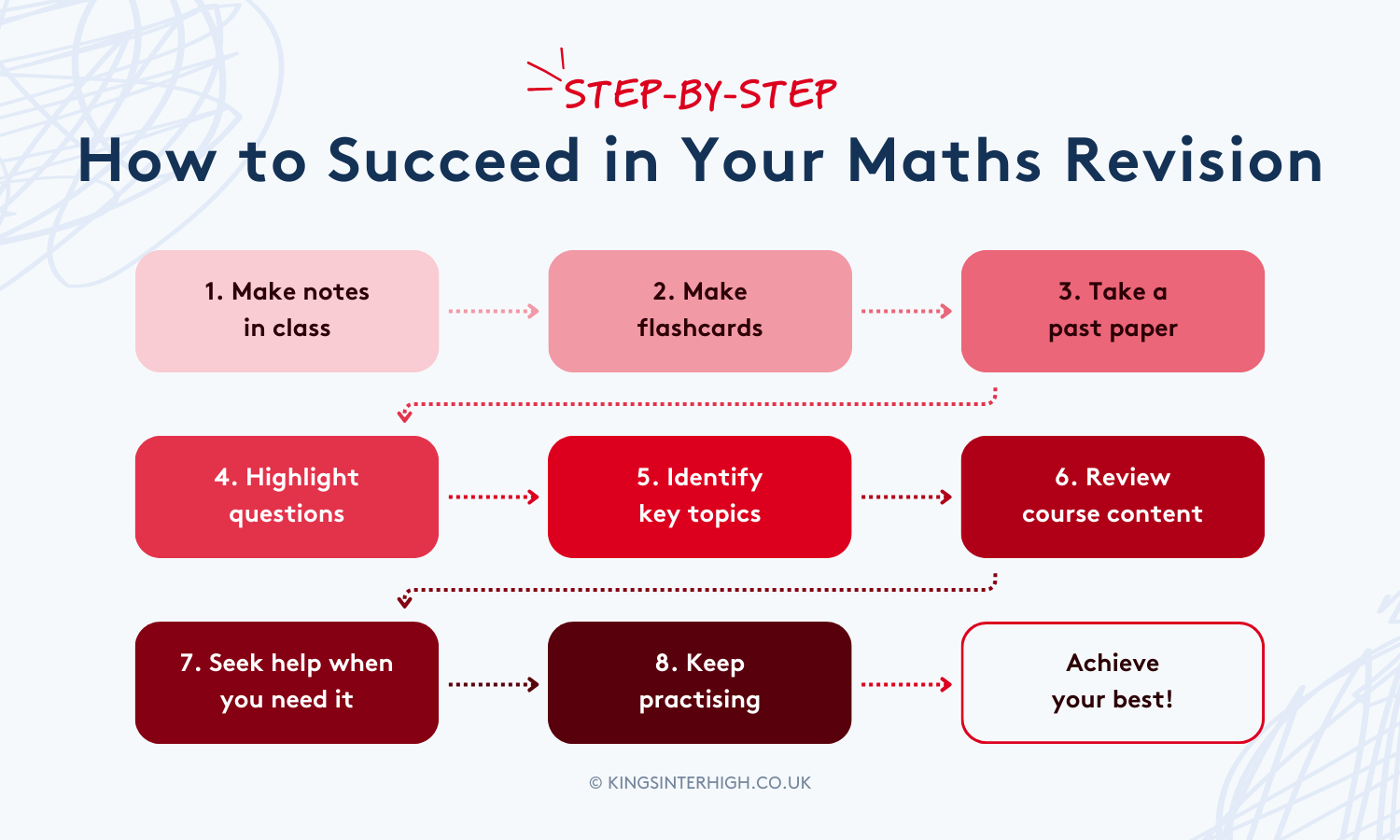
8 steps to maths revision success
Naturally, learning how to revise can be a lot to take in, and it’s not always obvious where to go next. Want to make the most of your revision time? We recommend following these eight steps:
- Make notes in class: Successful practise testing requires making notes for future reference. This ensures each concept is recalled from memory at least once and helps you build resilience, encouraging you to forge ahead with challenging material until you can remember it.
- Make flashcards: Flashcards are particularly effective for memorising key formulae. Students can create cards with prompts and answers, sort them based on how well they can remember them, and repeatedly review cards they haven’t remembered until all are remembered correctly.
- Take a past paper: Once you have a solid foundation of knowledge, you can take a past paper to get a sense for where you need to improve. Remember to begin by reading all the questions to get an overview of the exam.
- Highlight questions: Identify the questions you can already solve on the past paper as well as those that require more attention. This will help you easily decide where to spend the most revision time.
- Identify key topics: Once you know which questions you’re struggling with the most, focus your revision on the topics you find challenging. You can then dedicate a bit less time to topics you feel very confident in.
- Review course content: As you revise, utilise the materials available to you. For King’s InterHigh students, this might include lesson recordings, PowerPoints, and examples from our learning platform. Students at traditional schools may focus more on textbooks and worksheets from the past two years.
- Seek help when you need it: Don’t hesitate to ask your teachers for help if needed. Our Explore teachers are available in timetabled slots year-round, even after study leave begins. In other schools, teachers may hold specific revision sessions during the study leave period.
- Keep practising: Even when revision gets challenging, try not to feel discouraged. It’s okay if you can’t remember complex topics on the first try. Keep attempting past paper questions and reviewing your answers to reinforce your understanding over time.
Achieving your best in maths
Preparing for your mathematics exams requires dedication, practise, and the right resources.
At King’s InterHigh, we are committed to supporting you every step of the way. By enrolling in our Revision courses, utilising past papers, and focusing on key topics, you can build the confidence and skills needed to excel in your exams. Remember, consistent practise and a positive mindset are your keys to success.
Good luck!
Share: