

Article March 25, 2026
A parent’s guide to special schools for moderate learning difficulties

Finding the right school for a child with moderate learning difficulties is both a practical and emotional choice. The system is complex, the terms can be confusing, and your options depend heavily on where you live.
This guide is here to cut through all of the noise and find the right school for your child. Let’s take a look at the main types of specialist provision available in the UK, what to look for in each, how to search effectively, and what to do when local options don’t meet your child’s needs.
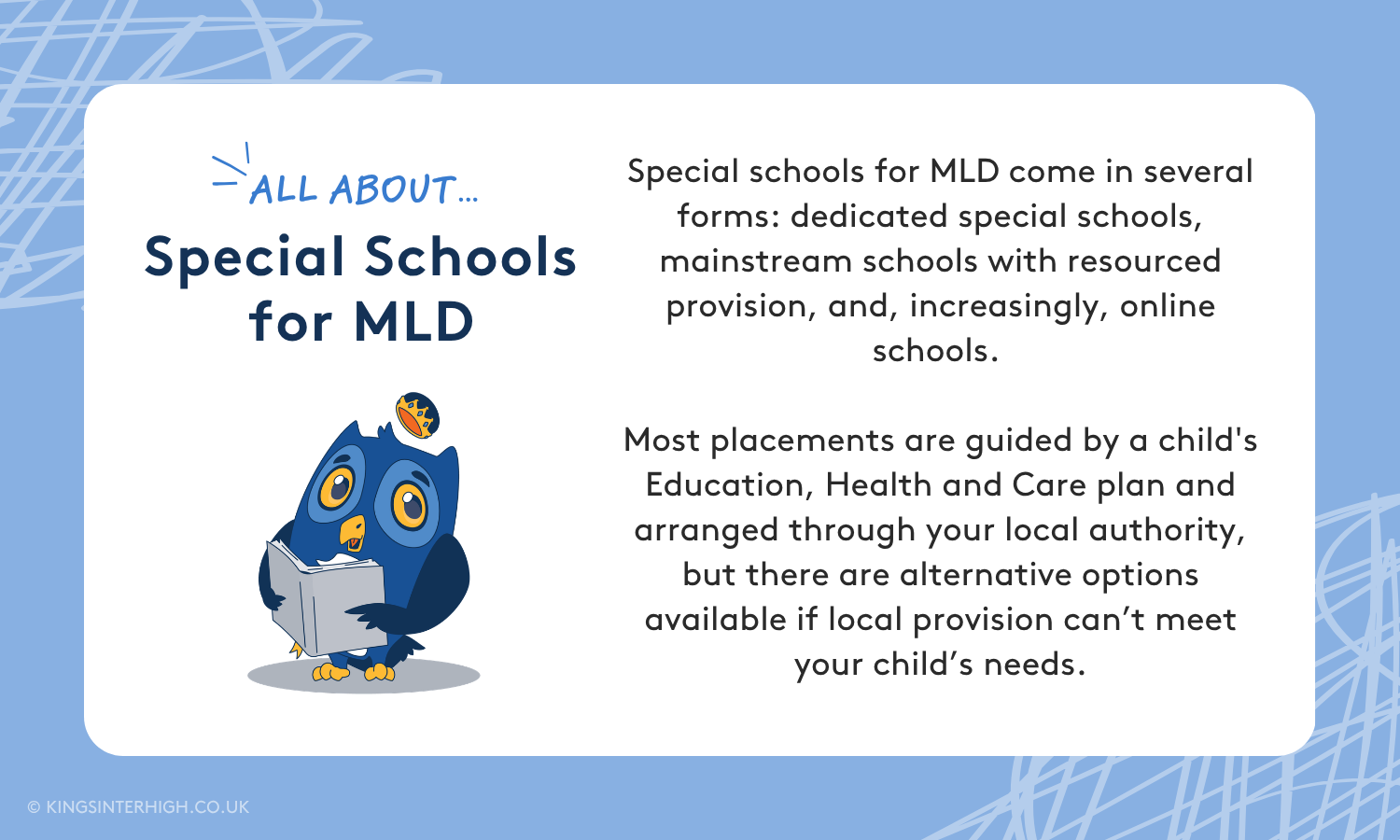
In a nutshell: Special schools for moderate learning difficulties (MLD) in the UK come in several forms: dedicated special schools, mainstream schools with resourced provision, and, increasingly, online schools. Most placements are guided by a child's Education, Health and Care (EHC) plan and arranged through your local authority. If local provision doesn't meet your child's needs, out-of-area placements and online schooling are both legitimate options worth exploring.
What are moderate learning difficulties?
The UK government’s official definition of “moderate learning difficulties” describes children who are working “significantly below expected levels in all core areas of the curriculum.” They typically find learning across most subject areas harder than their peers and may face challenges with a combination of literacy, numeracy, speech and language, and processing new information.
MLD is one of the most common types of special educational need (SEN) recorded in UK schools, representing more than 170,000 students in 2024-25 according to government figures. It sits between mild and severe learning difficulties (SLD), and it’s quite different from specific learning difficulties (SpLD) like dyslexia (which affect particular skills rather than general learning ability).
How does MLD affect a child in the classroom?
In a busy mainstream classroom, children with MLD can find it hard to keep pace. Lessons often move too quickly, instructions can be too complex, and the gap between a child’s ability and age-expected standards can widen over time.
Many children also struggle with their working memory, attention, and processing speed. Even when they understand something one day, retaining it the next can be genuinely difficult. Without the right support, this knocks confidence and makes school feel like a daily uphill battle.
What does good support for MLD look like?
Children with MLD in England are typically supported through the SEND framework. Many will have an Education, Health and Care Plan (EHCP or EHC plan), which sets out their specific needs and the provision they’re entitled to.
Effective support for MLD usually involves:
- A slower curriculum pace where teachers regularly reinforce core concepts
- Smaller class or group sizes
- More visual and practical learning approaches
- Speech and language therapy and occupational therapy
- Strong pastoral care and emotional support
The right educational environment makes all the difference to a child’s confidence and wellbeing, as well as their academic progress. That’s why so many families look beyond mainstream school for their children with MLD.

What types of specialist schools exist for moderate learning difficulties?
There’s no single right way to support children with MLD, and that’s actually a good thing. Different children need different environments, which is why the UK education sphere has developed several distinct types of provision that can work for students with learning difficulties.
| Type of provision | What it offers | Best suited to |
|---|---|---|
| Special schools | Fully specialist settings with small classes, on-site therapies, and high staff-to-pupil ratios | Children with significant or complex SEND needs |
| Mainstream schools with resourced provision | A specialist unit within a standard school, with children joining mainstream lessons where able | Children who benefit from both specialist support and inclusion |
| Pupil Referral Units (PRUs) | Temporary provision for students unable to access other settings | Children in transition or facing significant short-term difficulties |
| Post-16 / FE college provision | Specialist support within a further education environment | Young people with MLD moving into post-compulsory education |
Special schools are fully dedicated settings for children with significant needs, including MLD. They typically have smaller class sizes, specialist staff, and access to therapies like speech and language or occupational therapy. Some special schools focus specifically on MLD, while others serve children with a broader range of needs (including autism and complex difficulties).
Mainstream schools with resourced provision offer a middle ground. These are schools that mainly serve children without special educational needs but have a designated base (sometimes called additional resourced provision, enhanced learning provision, or internal provision) where students with SEND receive specialist support. Children can still join mainstream classrooms for lessons where they’re able to, getting targeted help without being fully separated from their classmates.
Alternative provision is less commonly associated with MLD, but it can support students who are temporarily unable to access mainstream or special school education (for example, during periods of significant difficulty or transition).
Post-16 and further education options also exist. Young people with MLD may move into resourced provision within a General Further Education (GFE) college, with access to both specialist support and mainstream classrooms.

What levels of support are available for children with moderate learning difficulties?
Even within the same type of setting, no two schools look quite the same. The level of support a child receives depends on their individual needs, and the best schools adjust that support as those needs evolve.
Support in mainstream schools
Mainstream schooling can work for many children with MLD as long as the right support is in place. In practice, that usually means a combination of in-class teaching assistant support, a personalised learning plan, and regular check-ins with the school’s SENCO.
The key question to ask any mainstream school is how they adapt their teaching, not just their support. A good teaching assistant helps, but a child with MLD also needs teachers who adjust the pace, break instructions into smaller steps, and check for understanding regularly.
Support in special schools
At special schools, usually receive a high level of personalised support throughout the school day. Class sizes are smaller than mainstream settings, and staff-to-pupil ratios are higher, with teams like teaching assistants and speech-language therapists often on site.
Support in resourced provisions
When students study within a specialist provision at a mainstream school, their level of support is led by their needs in a similar way. The balance between their specialist unit and their time in the mainstream classroom will often be guided by their EHCP and reviewed regularly, with staff supporting children in both the resourced provision and the wider school.
What makes for good provision?
The key to genuinely effective provision is how support evolves with the child. The best settings review progress regularly, adjust learning plans, and keep families involved in the conversation. Support should also be reassessed at the big transition points, like moving between key stages, to prepare children emotionally as well as academically.
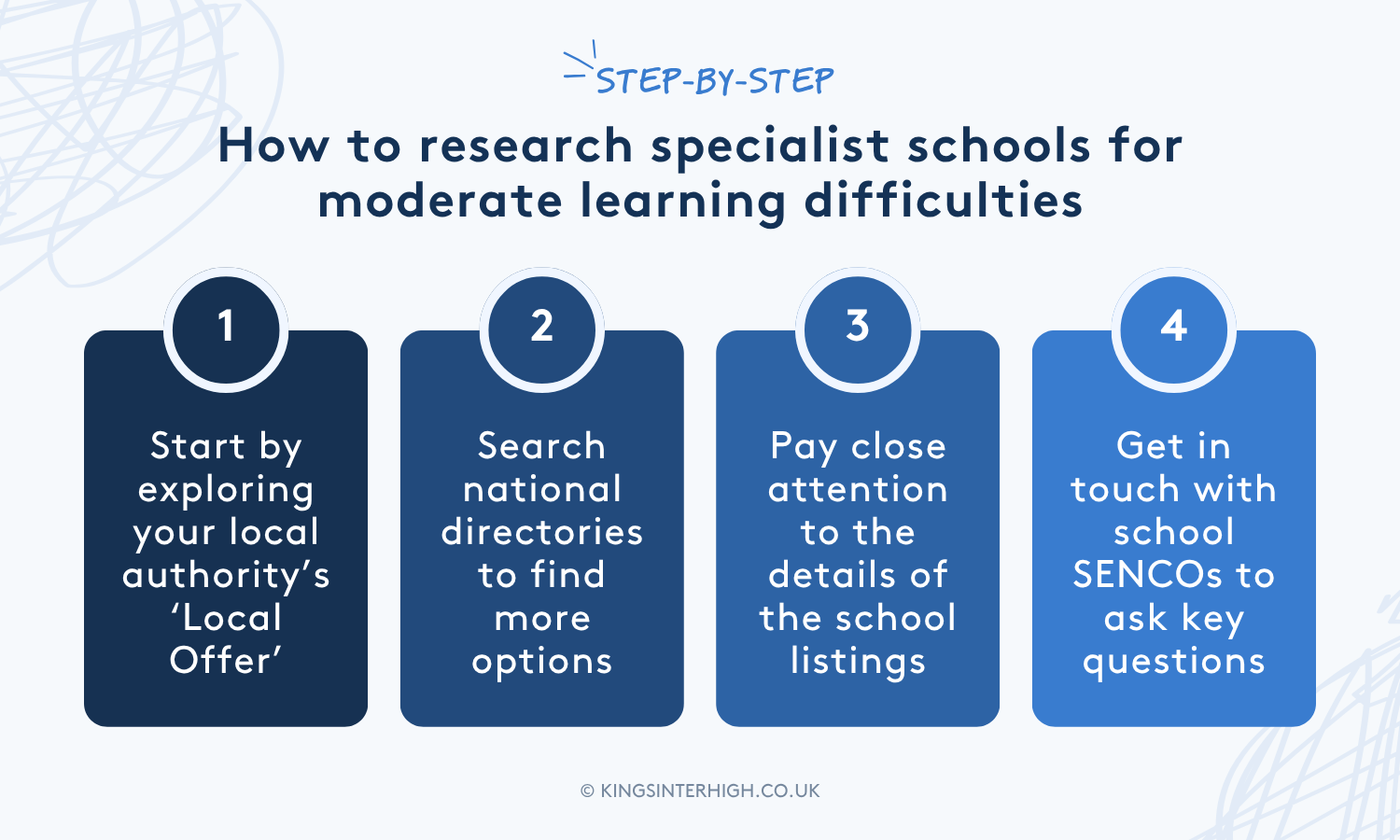
How to research specialist schools for MLD: a step-by-step guide
Finding the right specialist provision is one thing. Finding it close to home is another, and for many families, this is where things get frustrating.
In England, special schools and resourced provisions are managed and funded by local authorities (LAs), so the options available to your family depend significantly on where you live. Most LAs maintain a directory of the schools and provisions they oversee and will generally aim to place children within their own area first.
No matter where you’re based, it’s important to know how to search for a school and what to look for when you do. Here’s a practical starting point.
Step 1: Start with your LA’s Local Offer
Every LA in England is required by law to publish a Local Offer. It should include details of the specialist schools and provisions available in your area, including which settings cater specifically to children with moderate learning difficulties. This is always your most reliable starting point. Some examples include:
Step 2: Explore national directories
National directories, such as those provided by specialist SEND advisory organisations like Special Needs UK and Parentkind, can also help, particularly if you’re exploring independent special schools, non-maintained special schools, or options outside your borough. Many allow you to search by postcode and filter by type of need. When using them, look for terms like “MLD,” “moderate learning difficulties,” or “complex needs” to narrow results. Remember to also check whether listings are current, as directories aren’t always refreshed in real time.
Step 3: Know what to look for in a school listing
A school’s name and location are just a starting point. When reviewing any listing, check for:
- Whether MLD is listed as the primary specialism, rather than one of many needs the school says it covers
- Links to recent Ofsted reports, which give you an independent view of quality
- Whether the setting offers therapies, dual registration, or enhanced learning provision
- The age ranges covered, so you can plan ahead for transitions
- Which funding routes and eligibility criteria apply
Step 4: Get in touch directly
Once you’ve picked out some schools worth exploring, contact their SENCO (Special Educational Needs Coordinator) or admissions team directly. This is an opportunity to ask about things like class sizes, therapy provision, how they support children with MLD specifically, and whether you can arrange a visit.
Local parent groups and SEND forums can be equally valuable here. Families who’ve been through the process often share honest, up-to-date knowledge that official sources simply can’t offer.
What should you do when local provision isn’t enough?
Local authorities aim to place students in local provision to keep travel manageable, keep children connected to their community, and to make access to local employment and training easier in their future.
The reality, though, is that provision isn’t evenly distributed. Urban areas (particularly in London and other major cities) tend to have a broader range of settings and specialisms. Families in rural or more sparsely populated areas often find fewer options nearby, with the nearest suitable school requiring significant travel.
If your local authority doesn’t have a suitable placement for your child, you can request provision from outside your LA (sometimes called an out-of-area or cross-borough placement). These placements do happen, but they require the LA to fund them, which means families sometimes face resistance.
If you’re in this position, consider seeking advice from a SENDIAS (SEND information and advice service). Your local authority website may be able to point you to a SENDIAS option in your area.
Could online schooling be right for your child with MLD?
For many families, a specialist school or resourced provision is exactly the right answer. But, if you can’t find the right environment nearby or the options available haven’t worked, you may want to consider online schooling as an alternative.
King’s InterHigh is a DfE-accredited school, and around 1 in 3 of our students have identified special educational needs. Supporting them is built into how we teach, with an inclusive, quality-first teaching (QFT) approach in every subject.
Similar to an in-person school, all our lessons are taught live and are interactive. What’s great is that they’re also recorded, so students can revisit content as many times as they need to. Participation is flexible too, which means students can contribute via camera, microphone, or written chat. For children who find the noise and pace of a traditional classroom overwhelming, it’s an environment that can make a real difference.

Our SEND support starts before a child’s first lesson at King’s InterHigh. Families begin by completing an Inclusive Teaching Plan (ITP) together with us: a personalised document that goes directly to every teacher, so they know your child’s needs before they arrive. From there, students have access to weekly SEN drop-in sessions, a dedicated tutor who monitors their wellbeing and progress throughout the year, and a weekly parent surgery with our Head of SEN Services, Laura Orme, for any questions or concerns along the way.
For families who need more targeted support, we also offer enhanced services: small-group social skills programmes, anxiety management courses, and literacy and numeracy support, all delivered by qualified practitioners. Plus, beyond lessons, children will find a wealth of ways to make friends comfortably.
Every child with MLD is different, but for families who need more options, flexibility, or control over how their child learns, it’s worth learning more about online schooling.

Your next steps
It’s easy to think of selecting the right special school for moderate learning difficulties as just a search: browse a directory, narrow down options, and make the transition. In reality, families who find the best environments tend to treat it as an ongoing conversation with their child, the school, their local authority, and other parents who’ve been there before.
Frequently asked questions
What is the difference between MLD and SLD?
Moderate learning difficulties (MLD) is a term used for children who have lower cognitive abilities across most areas of learning. Severe learning difficulties (SLD) describes a significantly higher level of need, often accompanied by additional complex needs. Children with MLD typically develop greater independence over time, and many go on to further education and employment.
Does my child need an EHCP to access a special school for MLD?
In most cases, you’ll find that an Education, Health and Care Plan (EHCP) is required for a child to be placed in a special school or resourced provision in England. The EHCP sets out your child’s needs and the provision they’re entitled to. To get one, you can request a statutory needs assessment from your local authority.
Can a child with MLD attend a mainstream school?
Yes, many children with MLD are educated in mainstream schools, often with additional support such as a teaching assistant, a personalised learning plan, or access to a resourced provision unit within the school. Whether a mainstream setting is appropriate depends on the child’s individual needs and the level of support available.
What should I ask when visiting a special school for MLD?
Ask about class sizes, the range of therapies available on site, how they track and communicate progress to parents, and how they support transitions between year groups, key stages, and into post-16. Ask to speak to the SENCO directly too, and if possible, to hear from other parents.
What if no suitable school exists in my area?
You can request an out-of-area placement from your local authority. This means your child attends a school in a neighbouring LA, funded by your home authority. These placements do happen, though the process takes time and sometimes requires advocacy. Online schooling is also worth exploring if local provision consistently fails to meet your child’s needs.
Can children with MLD learn effectively online?
For some children with MLD, online schooling offers genuine advantages: a quieter learning environment, flexible participation, and the ability to revisit lessons as often as needed. It’s not the right fit for every child, but for those who find traditional classroom settings overwhelming, or whose local options are limited, it’s a legitimate option with growing support behind it.
Share: