

Article October 6, 2025
Everything parents need to know about dyslexia support in schools

Dyslexia never defines a child’s potential, but the support they receive at school can shape their experience, confidence, and success.
Your child is entitled to the right adjustments, tools, and strategies to help them learn, but ensuring they’re getting the right dyslexia support in school can feel overwhelming as a parent.
Knowing what great support looks like makes all the difference, whether you’re advocating for more help at your child’s current school or searching for an environment that will truly uplift them.
If you’re not sure what support is available, how to ask for it, or the changes you can make as a parent, keep reading for our practical advice on getting the right support to help your child thrive.
What dyslexia means for your child
Whether your child has been diagnosed with dyslexia or you’ve noticed well-known signs like trouble with reading and spelling, it’s important to remember that they’re not alone. Around 1 in 10 people in the UK have dyslexia, making it one of the most common learning differences.
But what exactly does it mean to be dyslexic? Contrary to some misconceptions, dyslexia has nothing to do with intelligence or effort. At its core, dyslexia is a neurological difference in how the brain processes language, both written and spoken. It impacts various specific skills like breaking down sounds in words or deciphering letters, in turn affecting reading fluency, writing, and oracy.
The signs of dyslexia
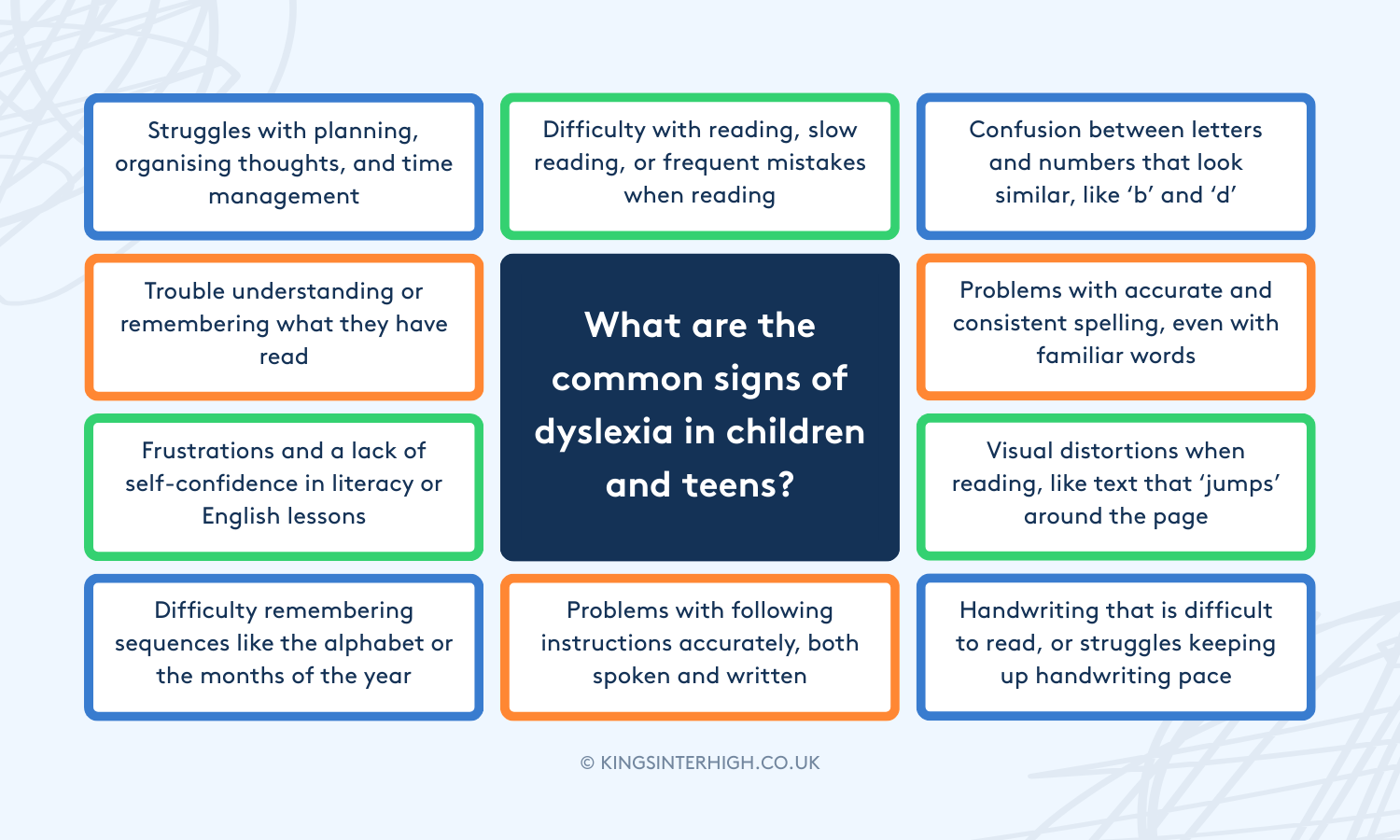
Early identification with a dyslexia diagnostic test is crucial; when you know your child has dyslexia, you can make sure they’re accessing all the right support. If you haven’t sought a diagnosis for your child yet, some of the most common signs of dyslexia include:
- Difficulty reading, or reading slowly with frequent mistakes
- Confusion between letters that look similar (like ‘b’ and ‘d’)
- Inaccurate and inconsistent spelling, even with familiar words
- Visual distortions when reading (such as text that ‘jumps’ around the page)
- Struggles learning foreign languages
What many don’t know is that dyslexia can also impact abilities outside of language; many children with dyslexia also struggle with planning, organisation, and maintaining focus, for example. Some signs can also be spotted before children begin to read and write, like delayed speech development or difficulty learning rhymes.
Dyslexia looks different in every child, and some experience only a handful of these signs whilst others face broader challenges. It can also commonly co-occur with other learning differences and neurodevelopmental conditions, such as ADHD and dyspraxia.
What’s just as important, but often overlooked, is that many children with dyslexia also display unique strengths because of the way their brains work. Some may excel at problem-solving while others may be highly creative, and these abilities are just as much a part of the overall dyslexia picture as their challenges.
How dyslexia affects learning
As many parents know well, dyslexia can create big hurdles for students, particularly in traditional classroom environments. The problem is that difficulties with reading and writing don’t just happen in isolation. When children spend all their mental energy decoding a text, it can be hard for them to comprehend and remember the actual content and information they’re reading. Writing answers can be just as exhausting, and students may not be able to get the most of out their learning if they can’t keep up with the pace of the class.
The same goes for staying organised with homework, focusing during lessons, and more. Left unsupported, these challenges can lead children to become frustrated, anxious, and reluctant to participate in class.
But here’s the crucial part: with the right support, children with dyslexia excel. Schools have a statutory duty to provide reasonable adjustments, and there are many modern teaching methods that have been proven to help dyslexic learners access the national curriculum successfully. For parents, the key is knowing what great support looks like so you can choose the best school environment for your child and advocate for their needs.
Your child’s right to reasonable adjustments
What every parent needs to know is that all children in the UK have the right to fully access their education, and many more countries around the world have similar laws.
In the UK, under the Equality Act 2010 (and the Disability Discrimination Act 1995 in Northern Ireland), dyslexia is recognised as a disability, which means that schools have a statutory duty to make reasonable adjustments for students. This is a legal requirement designed to level the playing field so your child can participate fully in school life.
While the term “reasonable adjustments” may feel vague, the law means that schools must provide accommodations that are tailored to your child’s specific needs as long as those adjustments are within their power. Many adjustments can be simple to implement, including extra time for exams, alternatives to writing for homework and projects, and access to assistive technology.
What works for one dyslexic student might not suit another, so your child’s school SENCO (Special Educational Needs Coordinator) and teachers should be working together with you to regularly review their needs. While schools should lead the process, your child’s voice matters too, so encourage them to express what helps them to learn best.

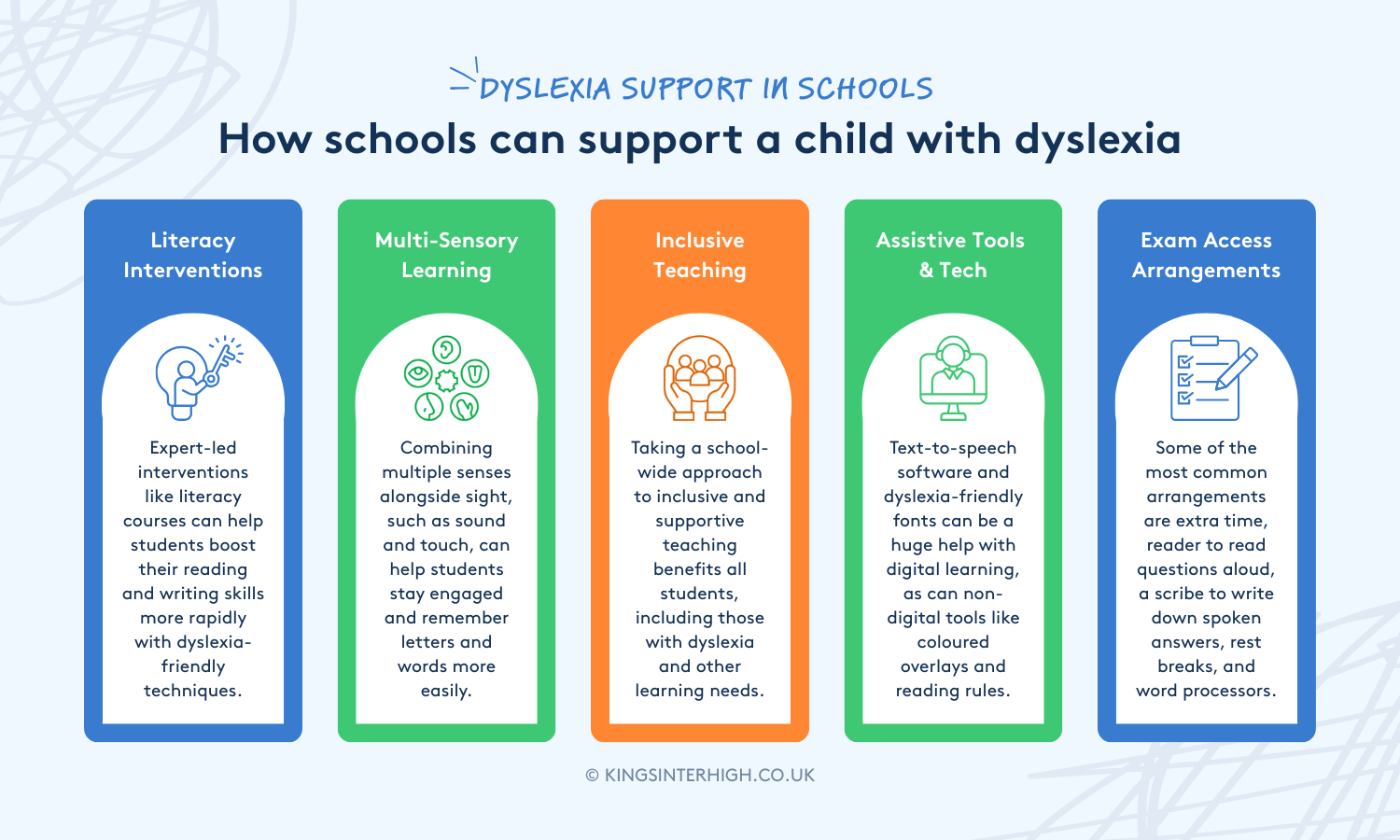
Dyslexia support in schools: 5 ways they can help
The right support can transform your child’s experience, help them make excellent progress, and give them the tools to enjoy each school day with confidence. What’s great is that dyslexia support in schools has been well researched over the years, and there are numerous tried and tested strategies your child’s teachers can use to help them learn.
What matters most is that the support available is tailored to your child’s needs and delivered by knowledgeable and compassionate staff. Schools that invest in ongoing professional development for staff and promote a whole-school commitment to inclusion will be able to provide the best support.
If you’re looking to point your child’s school in the right direction or you want to weigh up new school options for your family, here are some of great forms of support to look for.
1. Literacy interventions
If your child’s dyslexia has already been impacting their success at school, a structured literacy programme can be a great intervention to help build their skills.
Typically delivered in small groups or one-to-one outside of regular lessons, literacy interventions focus on dyslexia-friendly techniques that help children with their reading and writing. Depending on your child’s needs and age, this could include tailored help with recognising and forming letters, guidance on how to break down sentences, and more.
2. Multi-sensory learning
Dyslexic learners often benefit from learning through multiple senses at once rather than sight alone, particularly in the younger years. Multi-sensory learning combines sight, sound, touch, and movement to help concepts stick.
For example, a young child may remember the shape of a letter best when they say it aloud and trace it in sand; others may benefit from spelling words with physical letter tiles before they write them down. Alongside giving students more ways to build their skills, this style of teaching can also help keep them engaged.

3. Inclusive classroom teaching
Alongside specific strategies, the best schools also employ class-wide inclusive teaching methods. For example, teachers may implement a policy of breaking down all assigned tasks into smaller, manageable chunks that are easier for students with dyslexia to process. They may also provide handouts for all reading materials rather than asking students to copy text from the board, or provide a visual, colour-coded syllabus to help learners plan ahead.
Inclusion can also include celebrating a child’s individual strengths and empowering them to participate in a way that works best for them. Alongside each student’s unique abilities rather than solely focusing on their challenges, this can look like teachers allowing students to deliver an oral presentation or multimedia project rather than a written report. It can also include confidence-boosting strategies, like marking a student’s ideas separately from their spelling and grammar, so they can see where they’ve excelled as well as where they need to improve.
Every child can benefit from inclusive teaching, whether they have dyslexia or not, and weaving it naturally into the curriculum can help dyslexic students feel less isolated.
4. Assistive tools and technologies
Technology can be a huge gamechanger for dyslexia. If your child’s school uses gadgets like iPads in the classroom, find out what assistive technologies may be available to help them.
The most basic forms of assistive tech for students with dyslexia include tools we all use, like the spellchecker in Microsoft Word. But, these days, there are many more programmes and platforms available. Text-to-speech software, for example, reads the text on screen aloud for students who need support. Speech-to-text software, meanwhile, can allow a student to write an essay by dictating it. There are even specific fonts, like Dyslexie and Comic Sans, that can help increase contrast between letters and reduce confusion.
If your child’s school doesn’t provide tech equipment for students, there are also many non-digital tools that can be helpful in the classroom. Coloured overlays, for example, can be placed over text to alleviate visual stress while reading; reading rulers are a similar tool used to highlight individual lines of text, which reduces distraction.
5. Exam access arrangements
If your child is approaching their GCSE or A Level years, make sure they get the exam access arrangements they’re entitled to. Access arrangements ensure exams measure what your child knows, not how dyslexia affects their performance.
Some of the most common adjustments include extra time (typically an additional 25%), a reader to read questions aloud, a scribe to write down spoken answers, rest breaks, word processors, and modified papers with adjusted layouts or larger text. Schools can coordinate these arrangements on your child’s behalf to reflect how they best work in class, so ensure they’re discussed with you ahead of any application deadlines.
What you can do to support your child
You know your child best, and that knowledge is powerful. While it is the school’s responsibility to lead on implementing formal adjustments and interventions, your partnership with teachers can make a real difference to the outcomes. Similarly, so can your support at home.
Working with your child’s school
If you’re just starting out with getting support for your child’s dyslexia, a meeting with the school is a great place to begin. Make sure you come prepared with examples of your child’s struggles, insights on what’s working at home, and any ideas you have that could help your child in the classroom.
Be sure to document everything, from saving emails to taking notes, as this will help you take action if you feel like your child’s school isn’t doing enough. There are organisations and charities, like the British Dyslexia Association, that can provide you with guidance, and you always have the option to escalate complaints to the school’s headteacher, board of governors, or local educational authority (LEA).
Even when things are going well, it’s also a good idea to stay in regular contact with your child’s class teacher and SENCO. Having a line of communication, like an email address, means you don’t need to wait for parents’ evening if something isn’t working for your child.
Supporting your child’s learning at home
While your child’s teachers focus on the curriculum at school, you can focus on confidence at home. Uplifting and supporting your child can make the world of difference to their self-esteem, which will have a big impact on their progress.
When reading at home, for example, make sure it feels enjoyable rather than feeling like a chore. It may help to read materials your child is truly interested in, like comic books or encyclopaedias. With younger children, try literacy toys like magnetic letters or educational tablet apps that make learning feel more like play.
Even having regular conversations can be a huge help in building the self-awareness and confidence that will set your child up to advocate for themselves as they grow.

Why online school is great for dyslexia
If you are looking for a school with better support for your child’s needs, why not consider online learning? In many ways, top online schools like ours at King’s InterHigh are just like learning in an in-person classroom. But, online learning can also offer many unique benefits that are great for children with dyslexia.
At King's InterHigh, my teachers understand that I have dyslexia. I’m able to message them to ask exactly what they want me to do for a task, and they’ll explain everything.
Vegan TV chef and King's InterHigh IGCSE student
For example, here are just some of the reasons why students with dyslexia love learning at King’s InterHigh:
- Inclusive Teaching Plans – From the moment families join us, parents can set up an Inclusive Teaching Plan (also known as an ITP) for their child. As part of this plan, you can select all the best support strategies for your child’s needs. Our teachers can then see and implement these strategies (such as additional support with tasks, or extra time during tests) in every lesson.
- Inclusion-first teaching – One in three of our students have special educational needs, so we make sure our engaging online classes work for everyone. Our teachers undergo regular professional development to better understand the needs of every child and ensure students get the most out of their learning. Inclusive teaching strategies can include everything from providing examples for all tasks to “chunking” information to account for children’s shorter memory spans.
- Built-in assistive tech – Our state-of-the-art virtual classrooms and school platforms have assistive technologies (like text-to-speech and dyslexia-friendly fonts) built in directly. Students can then adjust these settings to their needs at any time without needing to request any special access.
- Focused classrooms – Unlike physical classrooms, virtual lessons are also free from the usual distractions students with dyslexia may find challenging, from behavioural disruptions to sensory overwhelm. This allows students to learn and work in a focused environment without losing all the benefits of class collaboration and discussion.
- Lesson recordings – All live lessons are made available as recordings, which students can watch at any time, 24/7. This is perfect for students who benefit from learning at their own pace, giving them the opportunity to go back and rewatch their teachers’ explanations on any challenging material.
- Enhanced Support Services – On top of all the support included at King’s InterHigh, we also offer a range of optional Enhanced Support Services designed around specific needs. Our expert-led Literacy Support course, for example, is designed to help children with dyslexia boost their reading and writing skills.
Online schooling has also allowed me to recognise my full potential through my dyslexia diagnoses, with incredible support from not only my peers but from the whole school community. I will forever be thankful for King’s InterHigh.
King's InterHigh A Level alumnus, A*BB (2025)
What’s next?
With the right support at the right time, dyslexia doesn’t have to make school a challenge to overcome. What works for your child will be unique to them, and armed with knowledge of what support is available, you have the power to make sure your child is thriving. Remember, you’re not alone, and you’re not being pushy: your child has a right to truly learn in class, not just sit through lessons feeling alone.
Want to explore online learning for your child? Join our next open event to learn more about King’s InterHigh, or book a discovery call to find out how we can support your family’s unique needs.
Share: