
Article June 3, 2025
Transition to secondary school: How to support your child

Trouble finding classrooms, forgotten PE kits, and struggles making friends — the leap to Year 7 can be a lot for an 11-year-old to handle. As the transition to secondary school approaches, it’s only natural to feel worried as a parent or caregiver too.
Whether you’re concerned about how your child will handle new buildings, multiple teachers, complex timetables, or losing their primary school classmates, you’re not alone if you’re filled with concerns.
That being said, the secondary school transition doesn’t have to be stressful. The right support makes all the difference, and with thoughtful preparation and pre-emptive action, you can help your child adapt quickly and happily.
Transitioning to secondary school
The jump from primary to secondary school is one of the biggest transitions your child will face in their educational journey. Having guided hundreds of students through this change, we’ve seen firsthand how it affects young people on multiple levels.
Secondary school introduces a complete geographical shift: bigger buildings, multiple classrooms, and the need to navigate between them quickly. Gone are the days of a single teacher and classroom. Instead, students encounter specialist teachers for each subject as they move from a Key Stage 2 programme to the more demanding Key Stage 3 curriculum.
This organisational shift requires new skills. Students suddenly need to manage different books for various subjects, follow complex timetables, and establish a homework routine that works. Independent study time becomes essential, not optional, and even academically strong students can struggle with these practical demands at first. Socially, children must also build new friendships while possibly being separated from primary school friends. This requires developing social skills in a fresh environment where everyone is finding their place. It’s worth noting that this transition often coincides with puberty, adding another layer of complexity to an already challenging time.
We often see parents concerned about separation anxiety or even school refusal during this period — these worries are completely normal. As a result, many schools offer transition events or activities to help ease these challenges for the whole family, focusing on both academic preparation and emotional wellbeing.
How to support your child through the transition
During the transition to secondary school, your role as a parent or caregiver is absolutely crucial. With the support of their parents, children tend to adapt more quickly and confidently, taking on their secondary school journey with ease.
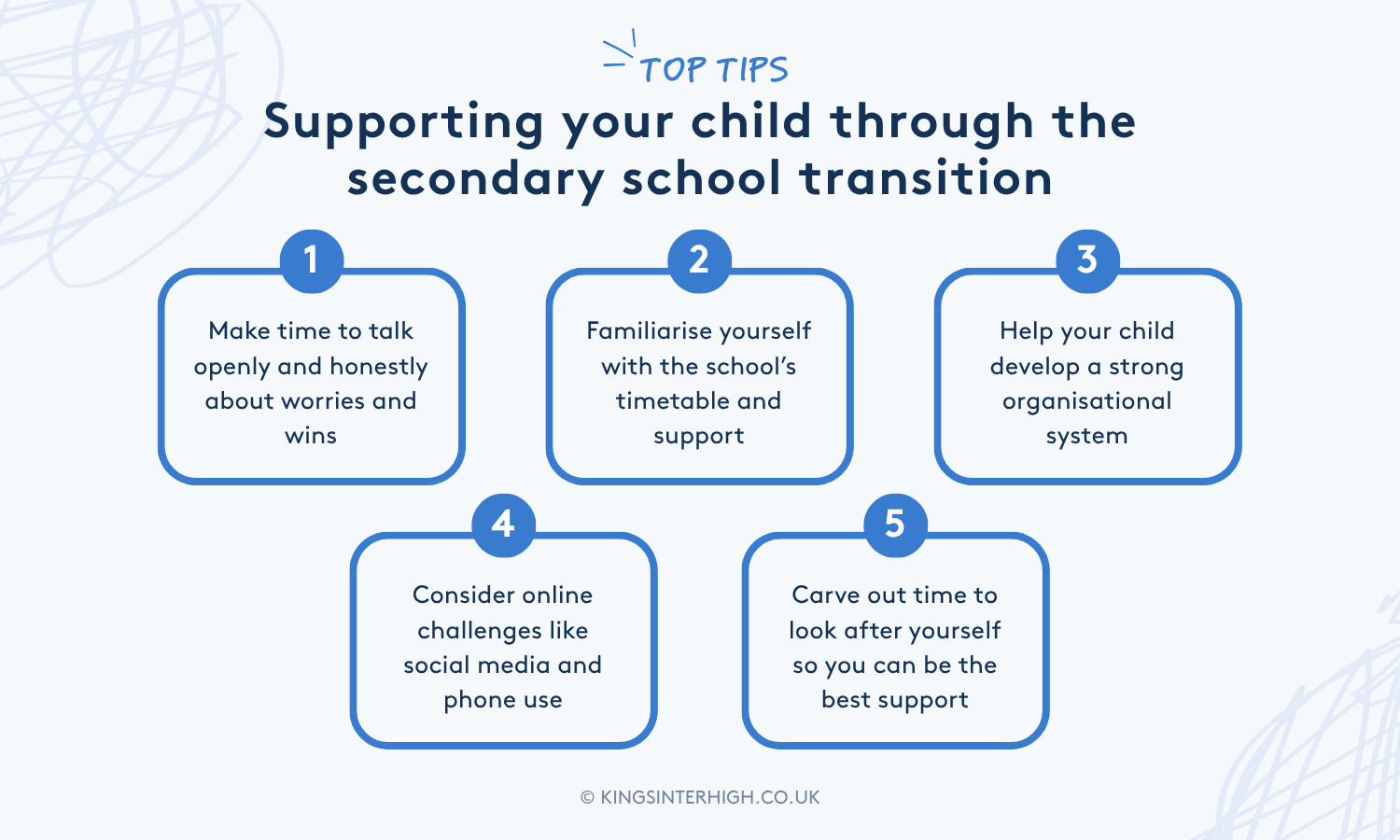
Here are some of my top tips for providing support and guidance as a parent:
Make time to talk
Building an open and honest relationship with your child creates a foundation for them to share worries and wins. Make time for regular chats about how they’re feeling — not just about academic achievement, but also social concerns like potential bullying. Listen more than you speak, and validate their feelings even when they seem overblown.
Become an expert
Familiarise yourself with your child’s Year 7 timetable and any available transition support. Many schools offer teaching resources you can use at home to help bridge knowledge gaps. When you’re informed, you can better support your child’s journey.
Help them get organised
Independence grows through practice. Help your child develop organisational systems that work for them rather than doing everything yourself. A simple colour-coded folder system for different subjects can work wonders for many students.
Consider the online world
Secondary school often brings new digital safety challenges too. Now’s the time to discuss boundaries around social media and establish a healthy relationship with mobile phones. Some families find creating a phone parking station at homework time helps maintain focus.
Look after yourself too
Don’t forget self-care during this transition. As a parent, it’s completely normal to feel stressed as your child heads into Year 7. Remember that supporting your child doesn’t mean solving every problem. Sometimes, the best support is teaching them to navigate challenges independently.
Why take part in secondary school transition activities?
Good secondary schools don’t leave the transition process to chance. At your child’s school, you may find a range of structured activities on offer to help students get comfortable and confident long before their first official day.
If you’re still in the process of choosing a school, note that these programmes often reveal how much a school truly understands what new students need. The best transition activities help students build confidence, create connections, and see themselves as successful secondary school students before they’ve even started.
Transition weeks during the summer holidays, for example, have become increasingly popular. These intensive programmes give Year 6 pupils a chance to navigate the building, meet teachers, and form friendships before September arrives, and they work brilliantly for reducing first-day nerves. Holiday clubs run by secondary schools offer another way to build familiarity. Children get to use school facilities while making friends in a relaxed setting, which can make a massive difference for anxious students. Alternatively, schools may also offer one-day transition activities for Year 6 pupils in their final term.
Some schools also provide pupil resource packs that bridge the gap between primary and secondary school. These often include practical tools like checklists for packing their bag, timetable templates, and conversation starters, with a focus on practical independence as well as the emotional side of transition.
How do schools prepare their staff?
Wondering what to look for when determining whether a school’s transition programme is up to scratch? Behind every successful secondary school transition is a team of well-prepared staff.
The most effective schools provide their teachers with practical tools and training specifically for welcoming new students. This might include courses on adolescent development, workshops on supporting children with EHCPs, or guidance on running an effective buddy system. The SEN department typically works months ahead, preparing individualised support strategies. When speaking with prospective schools, feel free to ask staff about how they’re preparing for the first few weeks of Year 7.
Common secondary school transition challenges
While your support will go a long way in helping your child move up to Year 7, there’s no need to panic if your child’s experience isn’t smooth sailing. Some barriers can turn what should be an exciting journey into a source of real worry for children and their parents, but there’s always a way to overcome the challenges ahead.
What are the most common challenges?
Difficulties with the secondary school transition can vary greatly from child to child, but some of the most common are:
- Anxiety: The fear of new routines, teachers, and peer groups can trigger intense worries, sometimes leading to school refusal in more serious cases. This anxiety often impacts self-esteem and confidence, creating a cycle that’s hard to break without support.
- Bullying: Children who struggle to find their social circle may be particularly vulnerable to bullying in the early days. Many children who joined King’s InterHigh did so after feeling isolated and targeted when starting secondary school, which affected everything from their academic progress to their willingness to attend school.
- Organisation: Many students simply aren’t prepared for the jump in independence required. Forgetting books, missing homework deadlines, and struggling with time management creates academic disruption that can quickly snowball.
- Special educational needs (SEN): Children with special educational needs and disabilities (SEND) or existing mental health difficulties can sadly face additional challenges when moving up to secondary school. In particular, the loss of familiar support systems and routines can be particularly destabilising for young people in these situations.
How can you overcome these obstacles?
If your child is facing any of these challenges or working through similar obstacles, here are some of the best solutions to try:
Build school-home communication
Strong communication between your family and your child’s school can make a tremendous difference too. When parents and teachers share observations about a child’s adjustment, early signs of anxiety or school refusal can be addressed before they take root. A quick weekly email exchange between parent and form tutor, for example, can spot patterns that might otherwise be missed.
Work on gradual skill building
Building organisational skills gradually rather than expecting overnight independence is another effective approach for various different challenges. We’ve found that visual timetables, checklists, and colour-coded systems help many students take ownership of their school day. Parents can support this by checking in on organisation without taking over completely.
Ask about a buddy system
Peer-to-peer advice often works wonders. Hearing from slightly older students who’ve successfully navigated the same challenges provides reassurance in a way that adult guidance sometimes can’t. As such, schools that pair new students with mentors often see fewer transition problems.
Sign up for co-curriculars
For children facing social challenges, structured opportunities to build their social circle work better than leaving them to figure it out alone. Clubs, activities and small group projects create natural friendship-building opportunities.
Remember that most barriers can be addressed before they grow into major problems with early identification and the right support. Normalising these struggles can also eliminate the worry that prevents many children from seeking help during the first few weeks. When students understand that everyone finds something difficult about the transition, they’re more likely to ask for support rather than suffering in silence.
Where can you go for more support?
Even with the best guidance at home, some children will need extra support during their transition to secondary school. Knowing where to turn when challenges arise can make all the difference during the first few months of Year 7.
Your child’s form tutor should be your first point of contact for most concerns. They see your child daily and can spot patterns that might not be visible at home. Don’t wait for parents’ evening if you’re worried — a quick email explaining your concerns will often get a prompt response. Be specific about what you’ve noticed and ask what support is available.
If your child is neurodivergent, has special educational needs, or deals with mental health struggles, you can also contact the school’s SENCO directly. If your child has an education, health and care plan (EHCP), remember you’re entitled to request a meeting to discuss transition support. Schools can often arrange individual tours or additional visits for children with specific needs.
Outside of the school environment, several excellent organisations offer specialised support. The YoungMinds Find Your Feet project, for example, provides brilliant resources specifically for transition challenges. BBC Bitesize has a dedicated secondary school transition section with peer-to-peer advice from students who’ve been through it themselves. You may find that your child responds better to hearing from other young people rather than adults.
Considering online school
In some cases, during the transition period, parents find that the traditional secondary school environment simply isn’t the ideal fit. While many challenges can be overcome with the right support, some families also decide to explore alternative forms of education.
Over the years, a difficult time in Year 7 has led numerous families to join our community at King’s InterHigh. Online learning can provide students who have been bullied, struggled with sensory overload, or felt under-supported with a pathway that eliminates traditional barriers and offers the right environment to thrive.
Online secondary school can be particularly beneficial to children who:
- Experience social anxiety or have faced bullying
- Have special educational needs requiring a more adaptable environment
- Struggle with the sensory overwhelm of large school buildings (due to autism, for example)
- Need more time to develop independence and organisational skills
With a flexible, personalised approach to learning and a strong focus on wellbeing, King’s InterHigh brings families a high-quality, live, interactive education that’s designed to revolve around their child’s needs.
Find out more about supporting your child’s move to online secondary school from Jasmine Marshall-Fraser, our Head of Middle School.
Make your child’s transition a success
The transition to secondary school marks a significant step in your child’s journey to independence. With the right support, your tween can flourish during this time. Remember that setbacks are normal — missed homework deadlines and friendship wobbles are all part of the learning curve. By staying connected with both your child and their school, you’re creating a safety net that allows them to take risks, build resilience, and grow into a confident young learner.
Share: