

Article November 21, 2024
What is flipped learning (and why does it work so well)?

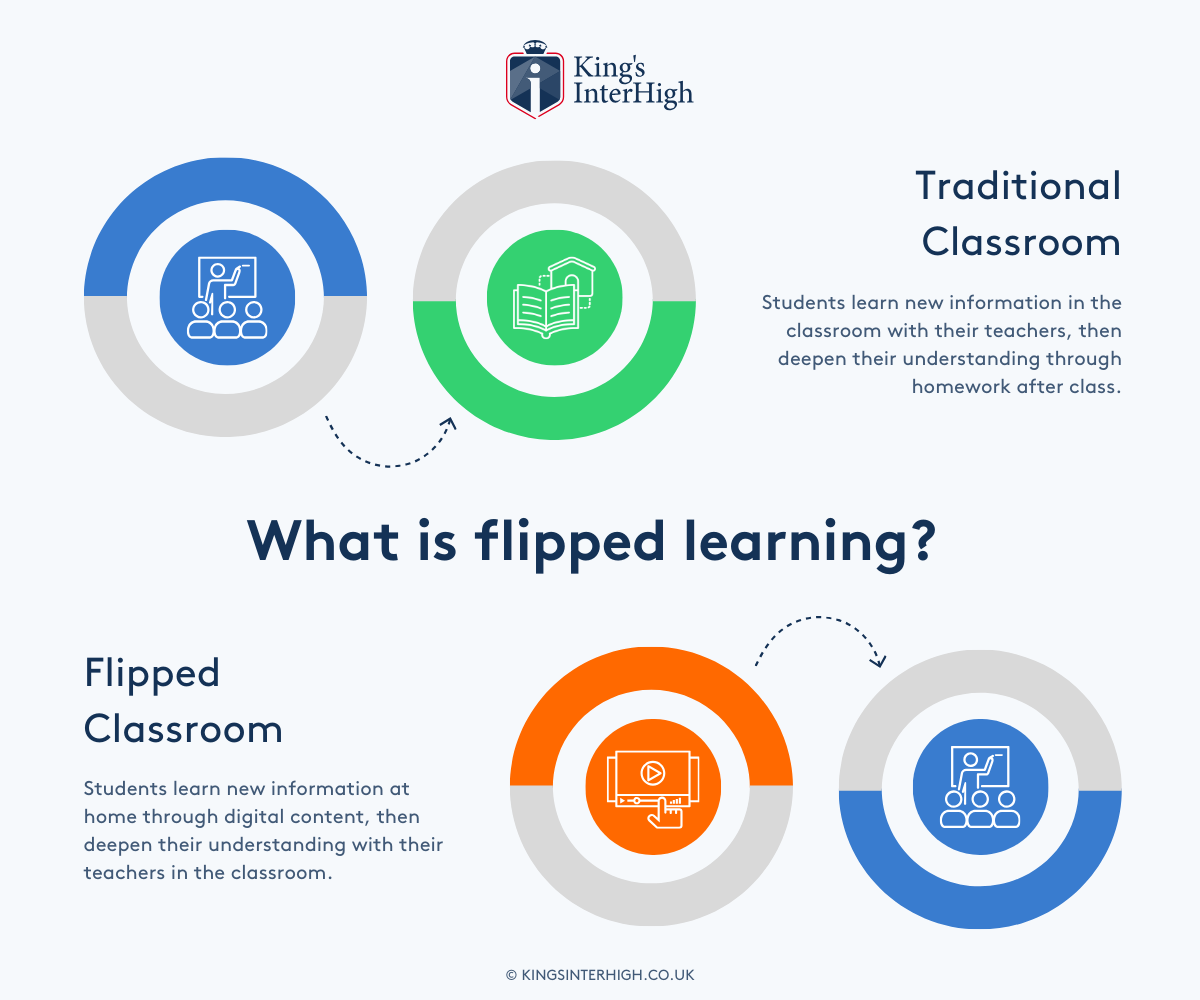
What comes to mind when you think of the average school lesson? If you’re like most, you might picture a teacher standing in front of the class, telling students new information and assigning them homework to solidify it.
Now, picture what school might look like if you turned that approach on its head.
Flipped learning is an innovative way of teaching that makes students the pilots of their own knowledge. Instead of studying new topics in class, learners work through the basics as “homework,” making lessons all about deeper exploration and engagement.
Wondering how it works, or why it matters at all? Let’s take a look at an introduction to flipped learning, the model’s unique benefits, and how we’ve taken it to the next level with online learning at King’s InterHigh.
What is flipped learning?
As the name suggests, flipped learning is a teaching approach that “flips” the conventional classroom model. Instead of finding out new information during lessons and practicing it through homework later, flipped learning sees students acquire that knowledge before their classes.
Using resources like video lectures, interactive guides, and reading materials, learners explore new topics independently ahead of lessons. This allows teachers to focus all their class time on diving deeper into each topic through group discussions, problem-solving, and other meaningful methods. By bringing in their expert knowledge, teachers following a flipped learning model are able to guide students to truly understand, engage with, and apply their learning.
The 3 core principles of flipped learning
There are many ways to explain flipped learning, but we find the most helpful is to sum it up in three principles:
- Pre-class preparation: Flipped learning introduces students to new concepts in their own time, typically using digital content like videos and presentations.
- In-class application: Students come to class armed with the basic knowledge they need. Instead of passively listening to lecture-style explanations, they instead spend their class time discussing topics, working on projects, and tackling questions or problems.
- Active learning focus: Ultimately, this creates a learning model with students at the centre, allowing them to take a greater, more active role in their own education and reducing anxiety.
The evolution of flipped learning
While flipped learning has risen sharply over the past few years, its roots go back much further. In fact, the foundations of this model can be traced to the 1990s, when Harvard physics professor Eric Mazur developed ‘peer instruction.’ Mazur’s pioneering approach built on the common idea of pre-class readings by transforming lectures into interactive materials students could use outside the classroom. He then used his class time to coach students on the content instead of lecturing.
By the late 2000s, the approach was already making its way into secondary school education. Two chemistry teachers at a high school in the US (Jonathan Bergmann and Aaron Sams) became among the first to use the model with younger students in 2007, when they started recording their lectures and posting them online for students who missed classes.
Now, flipped learning is gradually making its way into classrooms at forward-thinking schools worldwide — including here at King’s InterHigh — in part thanks to advancements in digital learning.
How tech is used in flipped learning
Thanks to the digital age, the potential of flipped learning is greater than ever. Virtual learning and classroom platforms, like the state-of-the-art tools we use at King’s InterHigh, allow students to access pre-recorded lessons, instructional videos, interactive presentations, and more.
The resources make the perfect base for flipped learning: Each learner can access their learning content in their own time (often the time they would have spent on extra homework) and work through it before their next class. It’s the perfect example of how technology and online learning can go beyond replicating the traditional school experience, creating a rich education that maintains the strength of long-established teaching foundations.

Why flipped learning matters
Flipped learning certainly isn’t the only way to teach students — particularly in an online environment with vast possibilities. That being said, it does address several key challenges that are often seen in traditional, in-person classrooms by:
- Encouraging students’ independence: When learning is flipped, young people take greater charge of their academic journeys. This can go a long way in developing their confidence and enthusiasm for knowledge.
- Maximising classroom time: There are only so many hours for lessons in a day, especially when it comes to ensuring students get a positive school-life balance. Flipped learning maximises these hours so students get the maximum benefit from their teachers’ knowledge, their classmates’ perspectives, and the tools available to them.
- Fostering deeper understanding: In flipped classes, learners reinforce each concept through active participation, which boosts understanding and retention. With a deeper understanding, students can then achieve higher grades.
Ultimately, flipped learning isn’t just a teaching technique — it’s a philosophy that redefines classrooms as spaces for engagement rather than instruction alone (just like we do with our virtual classrooms at King’s InterHigh).
The benefits of flipped learning
Flipped learning is more than just an idea. In just a few short decades, it has already proven to enhance both the learning process and students’ outcomes.
In particular, research has shown benefits across:
- Academic success: When Clintondale High School implemented flipped learning in every classroom in 2011, all students scored a C+ or above within 20 weeks — a stark contrast to their previous semester, when more than one in 10 students failed their classes.
- Student engagement: With more interaction time between students and teachers and more opportunities for active learning, children become more engaged in their classes.
- Cognitive load: One study in 2017 found that flipped learning can reduce cognitive load—the level of working memory we use while learning. This is particularly beneficial to students with special educational needs, who may be unable to process as much information as their classmates simultaneously.
- Student satisfaction: When done right, flipped learning can create an environment where students are happier with their learning. Studying subject matter before class can boost their confidence and make them feel more equal.
How flipped learning actually works
All this theory is great, but what does flipped learning actually look like in the classroom?
Since the concept is relatively new, all schools have their unique way of applying and implementing it. Some schools overhaul their whole teaching model, while others work elements of flipped learning into their existing ways of teaching. They may use resources created by external organisations, or they might develop their own content in-house.
From school to school, each element of the model varies. That being said, you’ll also find a lot of common points between them.
Foundations for flipped learning
Great flipped learning is generally underpinned by the same four pillars known as FLIP, first coined by Bergmann and Sams:
- F is for flexible environments, from adapted or virtual classrooms to flexibility in how teachers prepare each lesson
- L is for learning culture, referring to a school-wide emphasis on student-centred education
- I is for intentional content: creating or choosing materials that are meaningful, purposeful, and clear
- P is for professional educators, keeping teachers just as integral to learning as they are in traditional classrooms
Preparation for flipped learning
Rather than throwing students into the deep end with a new learning model, it’s important that schools set the stage for flipped learning by:
- Explaining the idea of flipped learning, so students know how to proceed before each lesson
- Making responsibilities clear to ensure that students don’t skip out on watching videos or completing readings before class
- Encouraging enthusiasm and independence to help students get on board with flipped learning and enjoy the process
Resources for flipped learning
Flipped learning can’t exist without the resources and tools that bring students new knowledge on each topic. Some of the best types of resources to use include:
- Recorded lessons
- Educational videos
- Presentations
- Interactive quizzes and games
- Engaging textbooks
What flipped learning looks like at King’s InterHigh
One of our cores at King’s InterHigh is the idea of personalised learning: we know that each student learns best when their education is dynamic, flexible, and designed to revolve around them. As the leading British international online school, we’ve been optimising our education for almost 20 years, bringing our students innovative, proven tools and techniques that match their learning to their needs, preferences, and academic stage.
Flipped learning is among the many methodologies we use at King’s InterHigh. It complements our school-wide learning model and empowers our inbound IGCSE students to excel.
Setting our flipped learning apart
Developed for the best learning experience, our unique model combines the principles of flipped classrooms with the experience and expertise of our wonderful teachers. Using their subject specialist knowledge and a deep understanding of how young people learn, our educators create engaging resources for each new topic on the curriculum. Everything is integrated into our cutting-edge virtual school platform, from the interactive video lessons they record to the gamified quizzes they craft.
This means learners can access new knowledge at the touch of a button, with the flexibility to learn it anytime. Depending on how they learn best, our students may work through sessions as planned into their timetables, work with their tutors and teachers to customise their schedule or follow the resources in their own time.
Armed with all that new information, students then take part in live, interactive lessons each school day, where they deepen their understanding through everything from teacher and classmate discussions to technologies like virtual and augmented reality.
Why our students love it
The result is a way of learning that allows each individual to take more control of their studies, mastering topics at their own pace. This offers unmatched benefits for students beginning their IGCSE journeys, taking on new and complex ideas they’ll need to fully grasp to achieve their best in exams. On top of that, it’s a great support for our students who choose online learning as a pathway that suits their special educational needs. Students with SEN, like dyslexia, autism, ADHD, and more often learn and process information differently than their classmates; with flipped learning, they get the flexibility and autonomy they need to accommodate that unique style of thinking.
At the same time, students don’t have to miss out on all the benefits of learning collaboratively with their teachers and classmates in real-time. Plus, we make sure they can reach out for help and feedback at any time as they work through their pre-class activities — whether that’s contacting a teacher with questions or asking for peer perspectives on their discussion board. This is particularly important for students who school avoidance
Putting your child at the forefront
When you choose a school where student-centred methods like flipped learning are the norm, you put your child at the forefront of their own academic journey. When young people take greater charge of their education, learning becomes more engaging, and students become more confident. In turn, school sets the stage for the bright outcomes and big futures that await them, arming them with the independence, skills, and passion they need to soar.
Want to learn more about how King’s InterHigh’s online learning model could work for your child? Reach out to us today!
Share: